Call us: +86-18965139230 | Mail to us: info@jekare.com

According to the 2025 U.S. Houzz Bathroom Trends Study, homeowners are increasingly prioritizing durable materials over purely aesthetic choices in bathroom renovations — a shift that’s now being reported alongside a specific finding: matte black’s popularity has plateaued in part because of documented durability limitations compared to more technical, wear-resistant finishes. For sellers who built listings and reviews around a finish that’s now facing a durability reputation problem, that’s not a styling footnote — it’s a supply chain problem with a paper trail.


A finish that looks flawless in a studio photo has to survive a different test entirely: parcel handling. Matte finishes show scuffs and fingerprints more visibly than gloss because there’s no reflective surface to hide micro-scratches, while a brushed or plated finish can look “off” the moment one unit in a batch comes out a shade warmer or cooler than the listing photo. The finish decision a brand makes at the design stage becomes a return-rate and review-score problem months later, once it’s actually moving through a fulfillment network.

For a seller, a finish problem rarely shows up as a manufacturing defect — it shows up as a 1-star review about a “scratched” or “different color than pictured” item, a return that eats the margin on that unit, or a chargeback dispute with no clear resolution. At scale, the same finish issue repeating across a product run compounds into return-rate data that a marketplace algorithm can penalize, independent of whether the coating itself was actually defective or simply mismatched to how the product would actually be shipped and handled.
Paint chipping and flaking are not simply “bad luck” — coating adhesion is a defined, testable property under ASTM D3359, the standard tape-test method used to rate how well a coating holds to its substrate on a 0–5 (or 0B–5B) scale. A finish that hasn’t been rated against this standard is an unverified adhesion claim, not a tested one.
“Color variance” isn’t just a visual impression either — ASTM D2244 defines how to calculate color tolerances and differences (commonly expressed as Delta E) from instrumentally measured color coordinates, which is what lets a manufacturer set a numeric tolerance for how far one production batch’s matte black or brushed gold can drift from the reference sample before it’s rejected, rather than relying on a visual “looks close enough” check.
The International Safe Transit Association’s ISTA 3A procedure is the general simulation test built specifically for individually packaged products shipped through parcel delivery systems — covering drop, vibration, and compression stresses that mirror what a box actually experiences moving through carriers like UPS, FedEx, or DHL. It’s a direct, named answer to “will this packaging protect this finish,” rather than an assumption based on how a product traveled in one past shipment.


In 2025, JEKARE worked with a North American ecommerce bathroom brand launching a single-handle basin faucet collection across three finishes — chrome, matte black, and brushed gold — with an initial order of 18,000 units and a forecasted annual volume above 60,000. Within the first three months, the brand noticed finish-related returns concentrated almost entirely on the matte black and brushed gold variants (5.8% and 6.4% respectively, versus 1.2% for chrome), even though all three shared the same body, cartridge, and internal testing standards. The brand’s first assumption was a coating quality issue and asked JEKARE to simply increase coating thickness and repeat salt-spray testing.
Instead, JEKARE ran a full finish failure analysis — ASTM D3359 adhesion testing, ASTM D2244 Delta E batch color measurement, an ISTA 3A packaging impact review, and controlled-lighting surface inspection — and found the coating itself wasn’t the problem. The matte black finish passed adhesion and corrosion testing; the actual cause was that matte surfaces diffuse rather than reflect light, so micro-friction marks from packaging contact during transit that were nearly invisible on chrome became clearly visible on black. The brushed gold complaints traced to a separate cause: batch-to-batch color drift that had been relying on visual approval rather than instrument measurement, which customers noticed when comparing the physical product to listing photos.
JEKARE’s fix matched each finish to a different process rather than applying one strategy across all three: chrome kept traditional electroplating with improved inspection; matte black moved to a higher-durability matte process paired with upgraded protective film, separated metal contact points, and drop-and-vibration-validated packaging; brushed gold moved to PVD with standardized master color samples and instrument-based Delta E tolerance checks before shipment.
Across the next 12,000-unit production cycle, overall finish-related returns dropped from 5.9% to 3.6%, matte black complaints fell roughly 45%, brushed gold color complaints fell roughly 50%, and the brand’s rating on its main ecommerce platform rose from 4.2 to 4.6 stars. The brand later extended the same finish strategy to two additional faucet collections.
Coating technology should be matched to the finish, not the other way around. PVD (physical vapor deposition) bonds a thin, hard metallic layer to the surface and tends to hold up better against scratching and fading than wet paint coatings, which sit on top of the substrate as an organic film and are more prone to chipping under impact — a distinction that matters most for matte black, since matte paint finishes show surface disruption more visibly than a matte PVD layer does. Traditional electroplating sits between the two, generally more durable than paint but with its own sensitivity to porosity and adhesion depending on the base metal prep. Before locking in a finish, ask which of these three processes it’s actually made with, and ask for ASTM D3359 adhesion ratings for that specific color and substrate combination rather than a general “durable finish” claim.
[Image suggestion — Jekare-PVD-Coating-Line.jpg | Alt text: “PVD coating production line at Jekare” | Links to: Surface Finishing capability page.]
Batch color consistency needs a number attached to it, not a visual sign-off. A documented Delta E tolerance under ASTM D2244, checked at inspection before a batch ships, is what actually prevents the scenario where unit 1 in a listing photo doesn’t match unit 400 in a customer’s hands — and that documentation is worth keeping alongside the product’s other certification records so a color complaint can be traced back to an actual batch measurement instead of a guess.
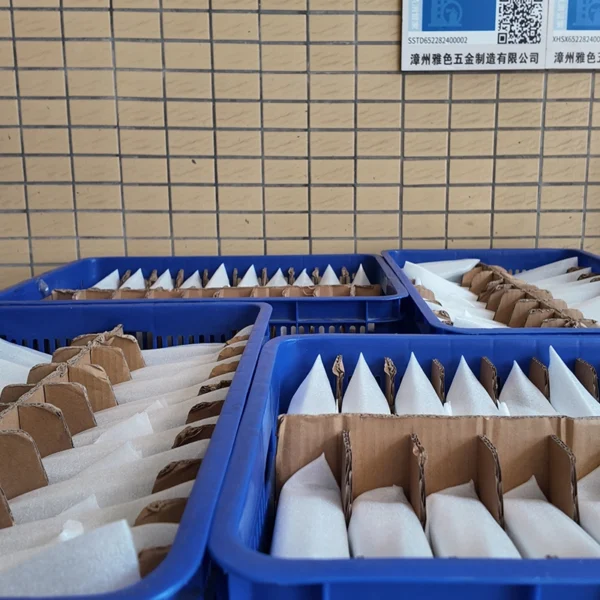
Packaging deserves the same scrutiny as the coating itself, particularly for matte finishes that show scratches more readily than gloss. Confirm whether the packaging and assembly process has actually been validated against a real-world simulation like ISTA 3A rather than a generic foam-and-box setup — a coating can pass every lab durability test and still arrive scratched if the packaging wasn’t engineered for the specific handling a parcel network puts it through.

Finish durability decisions extend past the product itself into how a listing performs — a color or coating documented to hold up under real shipping conditions is also a color a brand can market confidently as its return-rate data accumulates, particularly as a seller expands into new finish variants of an existing faucet line through OEM product development.
Brands that document coating adhesion, color tolerance, and packaging validation upfront are working from evidence when a marketplace flags a return-rate spike, rather than trying to reconstruct what happened after the fact — and that same documentation supports scaling a finish across more SKUs or production volume without re-litigating the same durability question for every new color a brand wants to add.
Finish and packaging questions are usually easier to work through against a specific product and target sales channel. Share your drawings or requirements for an initial engineering and manufacturing review.
Q: Is PVD coating more expensive than traditional electroplating or paint? A: Generally yes on a per-unit basis, but the cost comparison should account for return and replacement rates — a coating that survives shipping and daily use without visible wear can offset a higher unit cost through fewer returns and lower reverse-logistics expense.
Q: Why does matte black show scratches more than glossy chrome? A: A matte surface scatters light in multiple directions rather than reflecting it uniformly, which makes surface disruptions like micro-scratches more visually apparent than they would be on a reflective gloss surface, even when the actual depth of the scratch is similar.
Q: What Delta E tolerance is considered acceptable for a consistent product line? A: There’s no single universal number — acceptable tolerance depends on the color itself (darker, more saturated colors typically show smaller absolute differences less obviously) and the buyer’s own standard, which is why the tolerance should be a number both parties agree to and test against, not an assumption.
Q: Does passing ISTA 3A guarantee zero shipping damage? A: No — it’s a simulation of common parcel-network stresses, not a guarantee against every possible handling scenario a specific carrier or region might introduce, but it substantially reduces the likelihood of damage compared to packaging that hasn’t been validated against any standard.
Q: Can fingerprint visibility be addressed through the coating itself, or only through cleaning instructions? A: Certain coating formulations and surface textures show fingerprint oils less readily than others, so it’s worth asking a supplier whether a specific matte or brushed finish has been evaluated for fingerprint visibility, rather than treating it purely as a customer-care or cleaning-instructions issue.
Q: Should ecommerce sellers request different packaging for different finish colors within the same product line? A: It can be worth differentiating — a matte black or brushed finish that shows scratches more visibly may warrant additional protective measures beyond what a glossy chrome version of the same product needs, even though the underlying product and box dimensions are identical.
Emma Zhao is a Surface Finishing Engineer at JEKARE, specializing in PVD coating, electroplating, and paint finish development for bathroom hardware sold through both traditional distribution and direct-to-consumer ecommerce channels. She works with JEKARE’s design and inspection teams to align coating selection, color tolerance standards, and packaging validation with how a product will actually be handled and shipped, rather than treating finish and packaging as separate decisions. Her work focuses on helping brands document coating adhesion and batch color consistency so that finish-related returns and disputes can be resolved with test data instead of guesswork.
1.Houzz — 2025 U.S. Houzz Bathroom Trends Study
https://www.houzz.com/magazine/2025-u-s-houzz-bathroom-trends-study-stsetivw-vs~183227801
2.ASTM International — ASTM D3359, Standard Test Methods for Rating Adhesion by Tape Test
https://store.astm.org/standards/d3359
3.ASTM International — ASTM D2244, Standard Practice for Calculation of Color Tolerances and Color Differences
https://store.astm.org/standards/d2244
4.International Safe Transit Association (ISTA) — ISTA 3A Procedure Overview