1. Industry Background:
In retail consumer markets, “universal toilet seat” is a common marketing term. However, in B2B sanitaryware manufacturing, commercial project development, and OEM distribution, absolute universality does not exist. Bowl contours, mounting hole distances, and rim radii vary significantly across global regions and ceramic manufacturers.
1.1 Regional Profile Discrepancies Across Global Markets
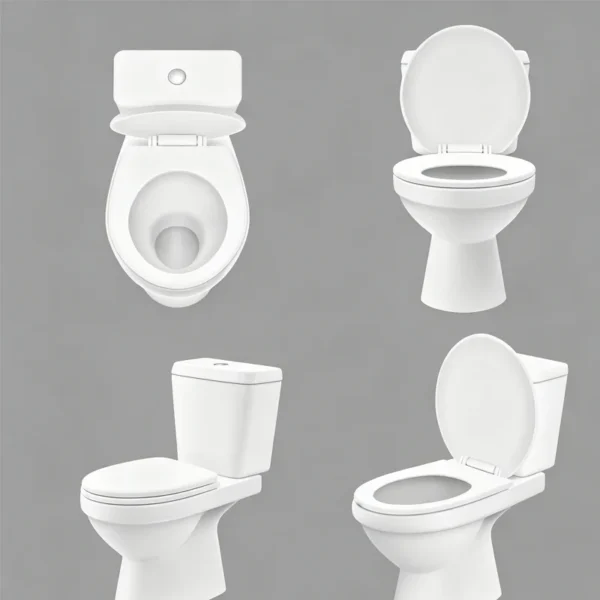
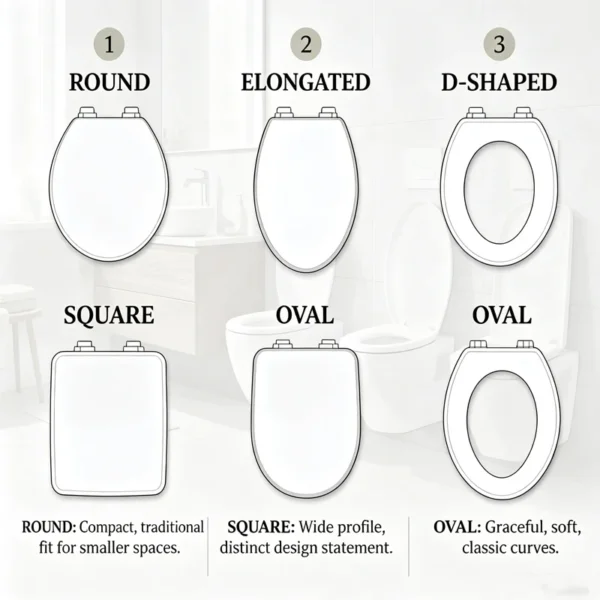
Ceramic bowl geometries are strictly divided by regional architectural and plumbing conventions. North American commercial installations predominantly utilize Elongated (approx. 470mm length) and Round (approx. 420mm length) profiles governed by standardized ceramic bowl molds. Conversely, European and Asian markets lean heavily toward European D-Shape, Square, and Compact V-Shape profiles, where length and width ratios differ by up to 35mm between brand series.
1.2 Ceramic Kiln Shrinkage and Dimension Variances
Even within the same product line, vitreous china ceramics experience a 10% to 15% volumetric shrinkage rate during high-temperature firing. This thermal distortion introduces a ±3mm to ±5mm tolerance variance in ceramic bowl length and mounting hole centerline spacing, making rigid, fixed-hinge toilet seats prone to overhang or misalignment.
1.3 The Push for Modular Facility Maintenance in B2B Projects
Commercial property operators, hospitality chains, and healthcare facilities increasingly demand standardized hardware solutions. Facilities teams require replacement seat platforms that can adjust to multi-brand ceramic inventory across properties without requiring custom tooling or specialized installation brackets.
2. Why It Matters: Financial and Operational Risks of Mounting Mismatches
For B2B buyers, product managers, and private label importers, treating toilet seats as a simple, single-size commodity leads to compounding supply chain costs and high customer friction.
2.1 Inventory Complexity and SKU Proliferation
Attempting to stock precise, non-adjustable seats for every specific ceramic profile forces distributors to maintain dozens of redundant SKUs. This drastically reduces warehouse space efficiency and ties up working capital in slow-moving inventory.
2.2 Elevated Return Rates and Aftermarket Warranty Claims
Mounting mismatches represent a primary driver of commercial returns. According to market research from
Grand View Research, improper fitment and hinge installation failures account for a substantial percentage of post-sale service claims in commercial sanitaryware sourcing.
2.3 Structural Stress and Accelerated Hinge Fatigue
When a seat overhangs the ceramic rim by even 5mm, user body weight is unevenly distributed across the support bumpers. This creates localized shear stress on the mounting bolts, accelerating fatigue in the internal soft-close damper and causing premature hinge failure.
3. Market Observation: Analyzing Standard Variations Across Major Regions
Recent technical evaluations of international sanitaryware shipments show that achieving broad compatibility relies on mastering three critical dimensional variables: hole centers, profile shape, and rim edge radius.
3.1 Mounting Hole Center Distances: 140mm vs. 155mm Standards
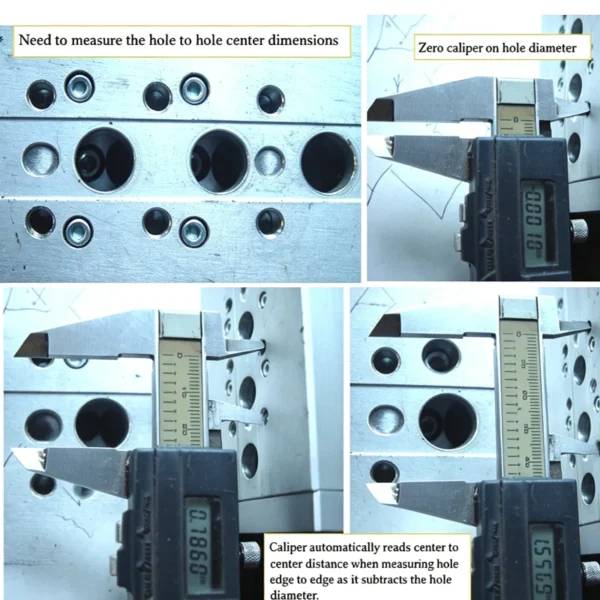
Standard mounting hole centerlines typically measure 140mm to 155mm (5.5 inches in North America). However, blind-hole top-fixing systems on wall-hung and back-to-wall ceramic toilets frequently feature hole spacings ranging from 120mm to 180mm. Mechanical standards, such as those maintained by
IAPMO / ANSI Z124, define physical performance and load testing parameters to ensure that mounting assemblies withstand lateral force limits without shifting.
| Profile Type |
Standard Length Range |
Standard Width Range |
Common Hinge Spacing |
Dominant Regional Markets |
| US Elongated |
460mm – 480mm |
350mm – 360mm |
140mm (5.5 in) |
North America, Commercial |
| US Round |
410mm – 430mm |
350mm – 360mm |
140mm (5.5 in) |
North America, Residential |
| Euro D-Shape |
420mm – 460mm |
350mm – 370mm |
135mm – 165mm |
Europe, Middle East, Asia |
| Universal V-Shape |
430mm – 470mm |
350mm – 360mm |
120mm – 180mm (Adjustable) |
Global OEM / Aftermarket |
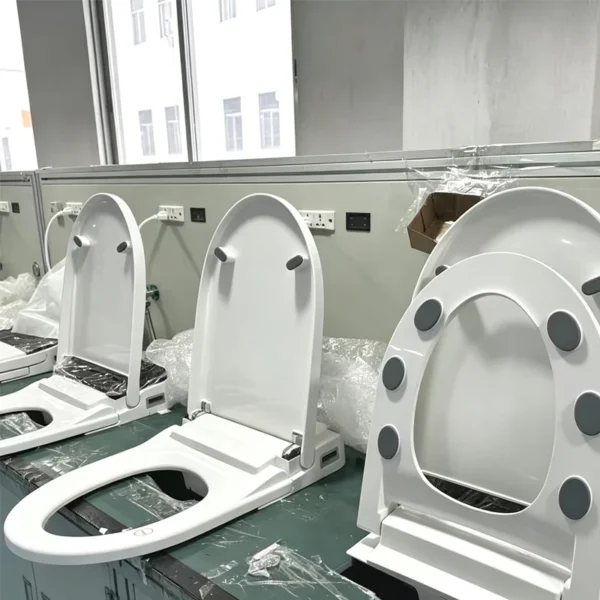
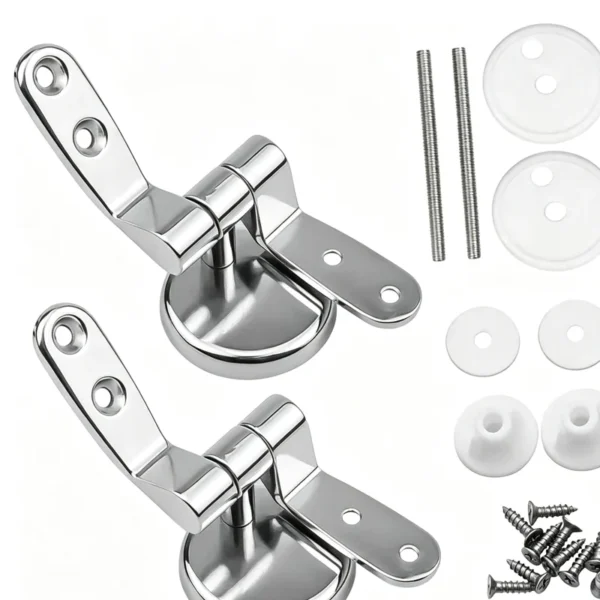
3.2 Polymer Material Selection: UF (Duroplast) vs. PP (Polypropylene)
Commercial procurement strategies dictate distinct material requirements based on target applications:
-
UF (Urea-Formaldehyde / Duroplast): A thermosetting polymer offering ceramic-like scratch resistance, high rigidity, anti-static properties, and resistance to chemical disinfectants. Ideal for premium hospitality and commercial projects.
-
PP (Polypropylene): A flexible thermoplastic with high impact strength, lower material weight, and crack resistance under structural flex. Preferred for high-traffic public installations and budget-conscious distribution.
3.3 Hinge Architecture Trends: Top-Fix and Quick-Release Mechanisms
Modern commercial specifications overwhelmingly require two technical features:
-
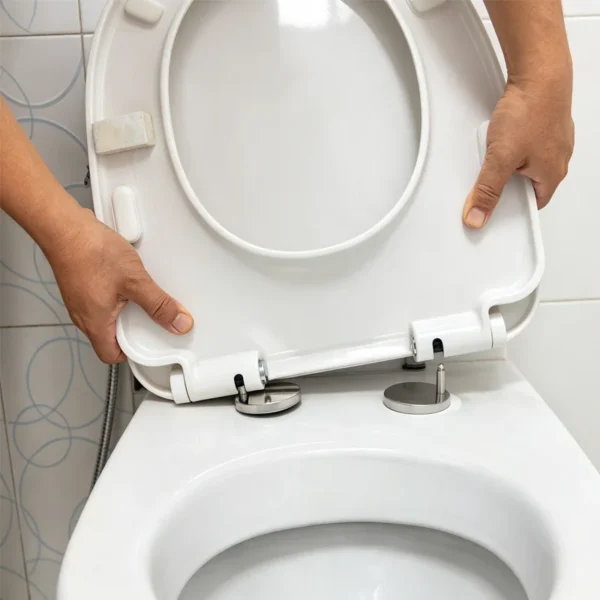
Top-Fix Expanding Bolts: Allows complete installation from the top of the bowl, eliminating the need to reach beneath concealed wall-hung toilets.
-
One-Button Quick-Release: Enables facility cleaning crews to detach the entire seat assembly in seconds, meeting strict hygiene protocols.
4. JEKARE Perspective: Solving Compatibility Through Modular Hinge Engineering
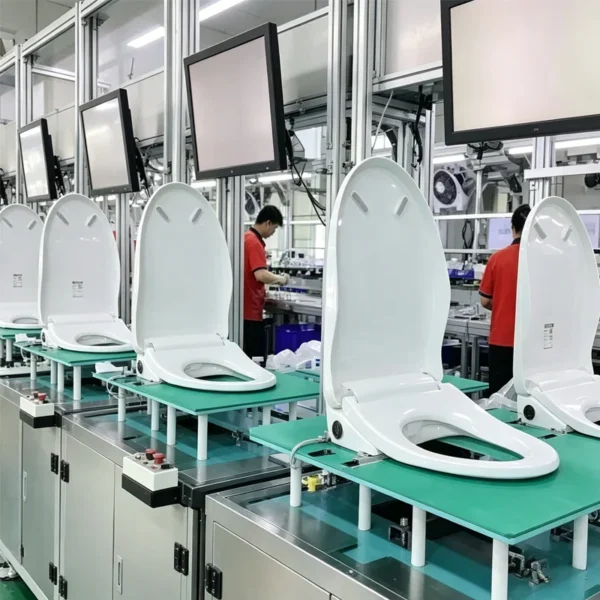
In our sanitaryware production operations, engineering teams frequently observe that fitment issues stem not from seat mold errors, but from rigid hinge plate geometries that cannot adapt to real-world ceramic firing variations.
4.1 Engineering 360-Degree Adjustable Hinge Plate Geometry
To bridge the gap between fixed seat molds and variable ceramic tolerances, JEKARE engineered an eccentric, 360-degree rotating stainless steel hinge plate system. By allowing micro-adjustments along both X and Y axes, a single seat mold can cover mounting hole distances from 130mm to 180mm while fine-tuning the front-to-back bowl alignment by up to ±12mm.
4.2 Controlling Polymer Mold Shrinkage in Production
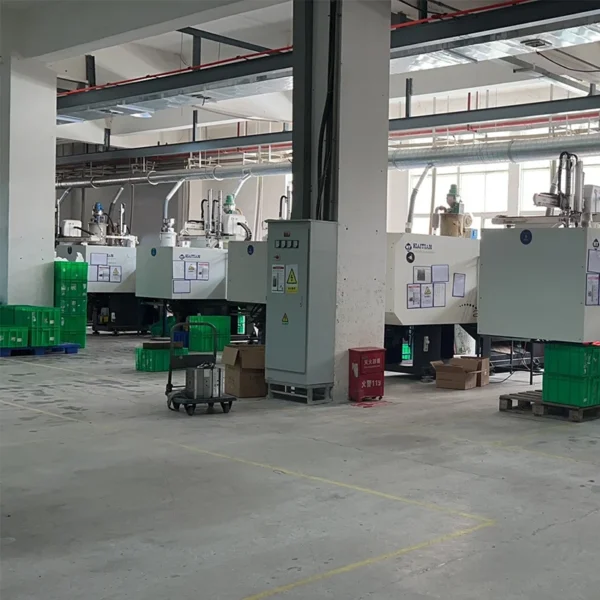
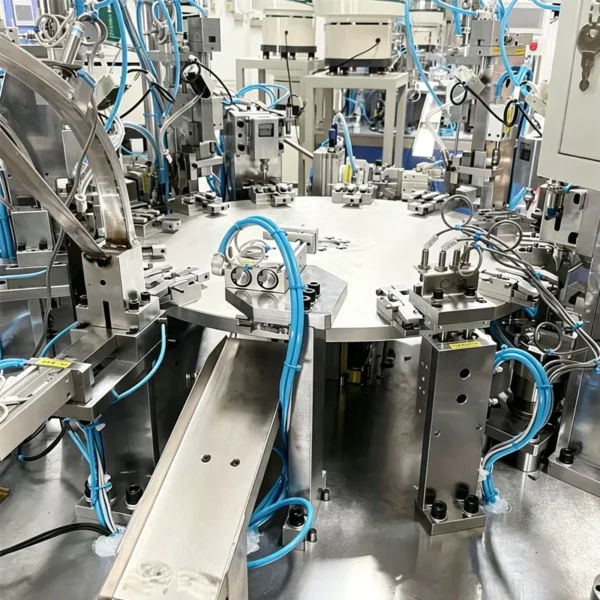
High-density Urea-Formaldehyde molding requires precise temperature and pressure controls to prevent warping along the outer rim. Our technicians maintain strict thermal parameters within the compression molds, keeping dimensional tolerances within ±0.3mm across large-scale production runs.
4.3 Product Focus: JEKARE Universal Adjustment Toilet Seat Platform
To help global brands simplify inventory while maximizing bowl coverage, JEKARE developed the
JEKARE Universal Adjustment Toilet Seat Series. Built on a modular platform, this product line incorporates high-density UF Duroplast construction paired with dual-push-button quick-release hinges.
B2B Procurement Advantage: Rather than sourcing separate seat SKUs for varying ceramic lines, purchasing managers can specify a single JEKARE platform that fits over 92% of standard European and Asian D-shape or V-shape ceramic models. Incorporating a hydraulic soft-close damper rated for over 100,000 opening/closing cycles and tested to support a 150kg static load, this series significantly reduces warranty replacement rates for commercial contract buyers.
5. Practical Decision Framework: Auditing OEM Toilet Seat Compatibility Standards
Before finalizing high-volume procurement contracts, purchasing teams should evaluate an OEM supplier’s toilet seat compatibility and structural integrity using this technical audit checklist:
5.1 Verification of Hinge Adjustment Tolerances and Load Limits
-
Does the hinge plate provide dual-axis adjustment to compensate for ceramic hole distance deviations?
-
Are the mounting screws made of corrosion-resistant SUS 304 stainless steel rather than plated carbon steel?
-
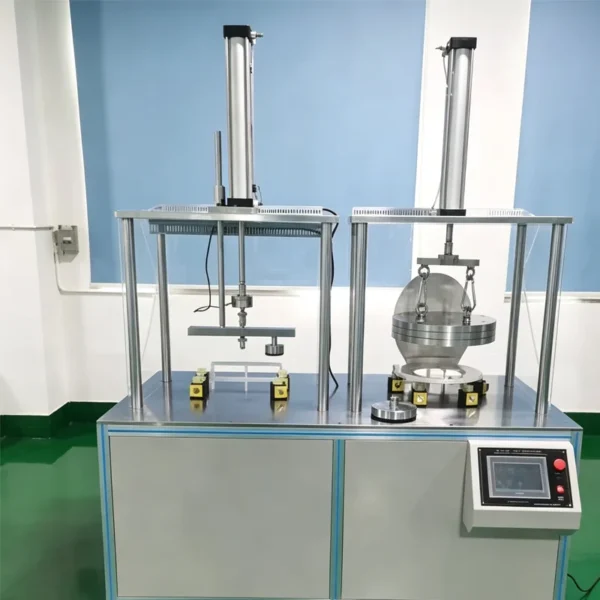
Has the assembly passed static weight testing (minimum 150kg / 330 lbs) without permanent hinge plate deformation?
5.2 Assessing Soft-Close Hydraulic Damper Performance
-
Does the supplier utilize fluid-dampened rotary cartridges that maintain consistent closure speeds (8 to 15 seconds) across temperature ranges from 5°C to 40°C?
-
Is damper lifecycle testing documented to exceed a minimum of 50,000 to 100,000 continuous cycles?
5.3 Reviewing Polymer Chemical and Stain Resistance
6. What This Means for Your Brand: Building an Optimized Toilet Seat SKU Strategy
Shifting from a fragmented catalog of specialized seat SKUs to a modular, highly adjustable product matrix offers immediate commercial and operational benefits for growing bathroom brands.
6.1 Streamlining Inventory Complexity and Working Capital
By adopting universal hinge platforms and versatile rim profiles, brands can consolidate their catalog by up to 40%. This reduction in active SKUs lowers warehousing overhead, optimizes container shipment density, and simplifies inventory forecasting for regional distributors.
6.2 Winning Commercial and Hospitality Procurement Contracts
Providing commercial clients with a durable seat platform featuring 30-second quick-release cleaning and universal mounting capabilities creates a strong competitive advantage in B2B bidding. Demonstrating long-term maintenance savings helps secure specifications in major hotel developments, housing projects, and commercial renovations.
Conclusion
While no single toilet seat lid fits every ceramic bowl on the market, advances in 360-degree adjustable hinge engineering and precise polymer molding allow global bathroom brands to achieve widespread compatibility across major regional standards. By understanding profile geometry, material selection, and mounting system mechanics, B2B procurement managers can reduce inventory overhead, lower warranty claims, and deliver reliable, high-performance sanitaryware solutions to their commercial partners.
FAQ
1. Are toilet seats standard sizes across all countries?
No. Toilet seat sizes vary by regional market. North America primarily uses Round (~420mm) and Elongated (~470mm) dimensions with 140mm hole centers, while European and Asian markets utilize D-Shape, V-Shape, and Square profiles with varying hole spacings (130mm–180mm).
2. How does a 360-degree adjustable hinge plate solve mounting discrepancies?
An eccentric 360-degree rotating hinge plate allows the mounting posts to pivot along X and Y axes. This flexibility enables a single seat to adjust to different hole centerline distances and fine-tune front-to-back seat positioning on the ceramic rim.
3. What is the difference between UF (Duroplast) and PP material for commercial seats?
UF (Urea-Formaldehyde) is a rigid, scratch-resistant thermosetting plastic with a ceramic-like finish, making it ideal for hotel and commercial installations. PP (Polypropylene) is a lightweight, flexible thermoplastic with high impact resistance, suitable for high-traffic or budget-focused applications.
4. How do top-fixing expansion bolts work on concealed toilets?
Top-fixing bolts utilize expanding rubber or stainless steel anchors inserted into the ceramic mounting holes from above. As the screw is tightened, the anchor expands underneath the hole, securing the seat without requiring access to the underside of the bowl.
5. What quality testing should B2B buyers require for commercial toilet seats?
Key quality tests include static load capacity (minimum 150kg), soft-close damper lifecycle testing (50,000–100,000 cycles), stain and chemical resistance testing, and salt spray testing for stainless steel hinge components.
About the Author
Sunny is a Senior Sanitaryware Product Engineer at JEKARE with over 20 years of experience in bathroom component development, polymer injection compression molding, and OEM manufacturing. He specializes in toilet seat hinge design, structural load optimization, material formulation, and international compliance standards. Working closely with global bathroom brands, distributors, and project buyers, Sunny focuses on creating reliable, maintenance-friendly OEM solutions engineered for global commercial markets.
References
-
Grand View Research – Toilet Seat Market Size & Share Analysis Report
https://www.grandviewresearch.com/industry-analysis/toilet-seat-market
-
International Association of Plumbing and Mechanical Officials (IAPMO / ANSI Z124)
https://www.iapmo.org/
-
International Organization for Standardization (ISO) – Quality Management Systems
https://www.iso.org/iso-9001-quality-management.html
Why Global Bathroom Brands Choose JEKARE
✔ 20+ Years of OEM & ODM Manufacturing Experience
✔ Complete Shower, Faucet, and Bathroom Accessory Solutions
✔ Professional Engineering Support from Concept to Mass Production
✔ Strict Quality Control and Certified Laboratory Product Testing
✔ Flexible Customization and Tooling Options for Global Markets
✔ Reliable Manufacturing Partner for Leading Distributors and Brands
Whether you require custom toilet seat platforms, bidet solutions, shower systems, or faucets, JEKARE provides engineering-driven OEM manufacturing support tailored to your project requirements.
Contact our engineering team to discuss your next bathroom product development project.