Call us: +86-18965139230 | Mail to us: info@jekare.com

Brass has long been the default material for faucet bodies because it balances cost, machinability, and durability well. But drinking-water disinfection chemistry works against it in a specific, well-documented way: NSF/ANSI 61, the American National Standard governing health effects of materials in contact with drinking water, exists specifically because components like brass faucets can impart chemical contaminants into water through leaching — and dezincification is the mechanism that drives brass-specific leaching over time.
Water utility research adds the disinfectant-specific piece of the picture. Peer-reviewed studies published through AWWA, the American Water Works Association’s journal, have found that both chlorine and chloramine — the two disinfectants most municipal systems use — actively accelerate dezincification by oxidizing zinc at the brass surface, with one frequently cited study finding chloramine concentrations as low as 0.1–1.0 mg/L increasing dezincification penetration depth in a roughly linear relationship. In other words, this isn’t a rare water-quality edge case — it’s a predictable reaction to disinfectant chemistry present in most municipal supplies.
For an OEM brand, dezincification isn’t a cosmetic issue — it’s a structural one that shows up as slow leaks, thread failure, or component cracking well after a product has shipped, often long after the warranty clock started. Because the failure mode develops gradually and depends on local water chemistry, it’s easy for a warranty claim to be misdiagnosed as a one-off manufacturing defect rather than a predictable outcome that proper inspection protocols can help catch earlier, tied to pairing standard brass with a specific disinfection and temperature environment.
NSF/ANSI 61 sets health-effects leaching limits for materials in contact with drinking water — it confirms a brass component doesn’t release contaminants above acceptable thresholds under standardized test conditions, but it isn’t a corrosion-resistance certification in itself. A brass alloy can meet NSF/ANSI 61 leaching requirements and still be highly susceptible to dezincification-driven structural failure over years of service, because the two properties are tested and governed separately during design and development.
AWWA-published research has identified a specific pH range (roughly 8–9) where a particularly aggressive form of dezincification, sometimes called “meringue” dezincification, becomes most problematic, and has found that chloride ions independently worsen dezincification propensity by increasing zinc solubility at the brass surface. That level of chemical specificity — not just “chlorine is bad for brass” — is what makes disinfectant type and local water chemistry a real engineering input, not background noise.
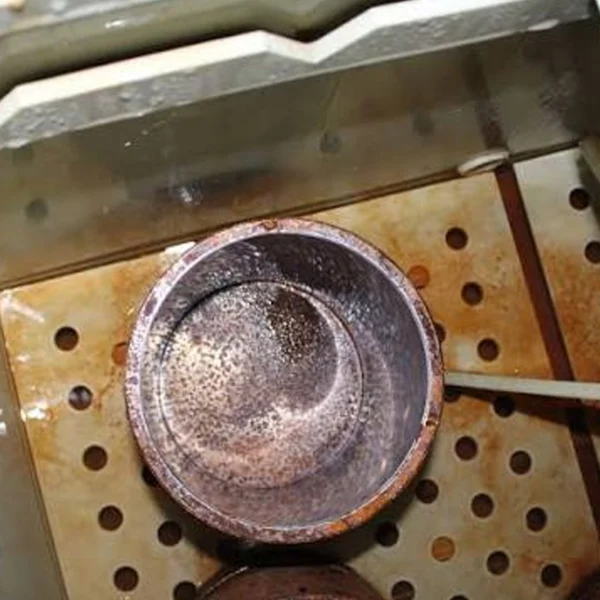
Brass is mainly composed of copper and zinc, and its corrosion behavior in chlorinated water is governed by electrochemical reactions between these metals and oxidizing chlorine species. In water systems, chlorine does not remain as molecular chlorine but forms hypochlorous acid and chloride ions, which create a continuous oxidizing environment.
In this environment, zinc becomes the first element to react because it is more electrochemically active than copper. It dissolves into the water as Zn²⁺ ions, while chloride ions stabilize the dissolved zinc and prevent it from redepositing. Over time, this selective removal of zinc gradually changes the internal structure of brass, turning it into a weak and porous copper-dominated matrix that can no longer maintain mechanical integrity.
Chlorinated water is widely used in municipal systems with typical free chlorine concentrations ranging from 0.2 to 1.0 mg/L. While this level is safe for human consumption, it continuously maintains an oxidizing environment inside plumbing systems. This prevents the natural formation of stable protective layers on brass surfaces and keeps the corrosion reaction active over long periods — which is consistent with AWWA’s finding that even relatively low chlorine concentrations can measurably accelerate zinc leaching, especially where water remains in extended contact with metal surfaces.
Temperature plays a critical role in accelerating brass corrosion. At lower temperatures below 20°C, the reaction rate remains relatively slow, and corrosion develops gradually over long periods. In typical cold water systems between 20°C and 40°C, the process becomes more noticeable but still progresses at a moderate rate.
However, once the temperature rises above 40°C, corrosion accelerates significantly, and in hot water systems above 60°C, the reaction rate increases sharply due to faster chemical kinetics and higher ion mobility. This is why brass components in hot water lines or recirculation systems tend to fail much earlier than those in cold water systems — a factor that has to inform design and development decisions for any faucet line marketed for hot-water-heavy applications.
During the corrosion process, zinc ions (Zn²⁺), copper ions (Cu²⁺), and chloride ions (Cl⁻) are gradually released into the water. In most normal residential conditions, these concentrations remain low and are governed by the leaching limits NSF/ANSI 61 sets, so they’re not typically considered a direct health hazard. However, they can still affect water quality by creating metallic taste, contributing to internal scaling, and increasing the risk of biofilm formation in plumbing systems. From an engineering perspective, the main concern is not acute toxicity but the long-term degradation of system reliability and water stability.
In real-world plumbing systems, corrosion is often more severe than in controlled laboratory conditions because water flow is not always continuous. In low-usage areas or dead-end pipe sections, chlorinated water can remain stagnant for long periods, increasing local chlorine concentration and extending exposure time. Additionally, when brass is connected to other metals such as copper or stainless steel — including angle valves and other fluid-control fittings in the same installation — micro-galvanic cells can form, further accelerating localized corrosion. These real-world conditions make system design just as important as material selection.
To improve the long-term performance of brass faucets in chlorinated water systems, engineers often rely on a combination of material selection, surface protection, and system design optimization. Dezincification-resistant brass (DZR brass) is commonly used because it improves alloy stability under chlorine exposure. Surface treatments such as nickel or chromium plating can also reduce direct contact between brass and water. In addition, system-level improvements such as reducing stagnant zones and maintaining stable water flow can significantly slow down corrosion progression.
In 2023, JEKARE supported a North American bathroom brand — supplying roughly 75,000 faucet sets annually through residential distributors and commercial renovation projects — through exactly this diagnostic process. The customer had standardized on one brass specification across its entire portfolio (bathroom faucets, shower mixers, thermostatic shower systems): standard brass alloy, nickel/chromium plating, NSF/ANSI 61 compliant material selection. It passed factory inspection and initial certification without issue. The problem only surfaced after the customer expanded into several U.S. regions running chloraminated municipal water.
A 12-month warranty review showed corrosion wasn’t the largest failure category — but it had a distinct signature the others didn’t:
| Failure Category | Share of Warranty Cases |
|---|---|
| Cartridge leakage | 38% |
| Installation issues | 21% |
| Surface finish complaints | 18% |
| Brass body/thread corrosion | 17% |
| Other | 6% |
At only 17% of total cases, corrosion looked minor in isolation — until JEKARE noticed the pattern underneath it: average failure time of 14–22 months after installation, 80% of cases concentrated in just three U.S. water districts, failures concentrated specifically in brass valve bodies and threaded connections, and initial factory inspection showing no abnormality at all. A delayed, geographically concentrated failure pattern like that points to environmental exposure, not a production defect.
Engineering investigation confirmed three common field conditions across the affected installations:
Microscopic inspection of returned samples showed the textbook dezincification signature: zinc depletion near brass surfaces, a porous copper-rich structure, and reduced mechanical strength specifically around threaded areas — consistent with exactly the failure mechanism this article describes.
JEKARE’s material comparison made the case for a regional rather than global fix:
| Performance Item | Standard Brass | DZR Brass |
|---|---|---|
| Zinc loss resistance | Standard | Improved |
| Chloramine exposure tolerance | Limited | Higher |
| Hot-water application suitability | Moderate | Better |
| Long-term corrosion resistance | Application-dependent | Improved |
Rather than switching the entire portfolio, the customer moved to application-based material selection: general residential markets kept standard brass; chloraminated U.S. regions moved to DZR brass; commercial buildings received DZR brass with enhanced validation; hot-water circulation projects prioritized DZR brass.
Field monitoring after the change:
The generalizable point: brass faucet durability can’t be evaluated through initial compliance testing alone. The same specification performs differently depending on local disinfectant chemistry, water temperature, installation frequency, and stagnation conditions — which is why brass selection deserves treatment as a market-specific engineering decision, not a fixed global default.
Rather than a generic question list, these are the specific conditions that AWWA and NSF-referenced research associate with elevated dezincification risk — worth checking against any target market before finalizing a material spec:
A program showing two or more of these conditions in its target market is a stronger candidate for DZR brass or protective plating than standard brass validated only to NSF/ANSI 61 leaching limits.
Corrosion in brass faucets exposed to chlorinated water is fundamentally an electrochemical process, but its severity is rarely determined by material composition alone — it’s strongly shaped by real plumbing conditions like stagnation, disinfectant type, thermal cycling, and multi-metal contact. That means improving long-term durability can’t rely solely on upgrading material grade; it requires treating water chemistry and installation conditions as design inputs, market by market.
For OEM and private-label programs, that argues for aligning material selection with inspection and manufacturing strategy per target region — building faucets adapted to a market’s actual disinfectant chemistry and temperature profile, rather than one brass grade assumed to travel everywhere equally well.
No — NSF/ANSI 61 certifies that leachate stays within health-effects limits under standardized testing; it doesn’t independently certify resistance to the structural degradation dezincification causes over years of service, which is a separate material and design consideration.
Both are oxidants that can drive dezincification, and AWWA-published research has documented both accelerating the process; which is more aggressive in a given system depends on concentration, pH, and other water chemistry factors rather than disinfectant type alone.
DZR brass significantly improves alloy stability under chlorine and chloramine exposure, but “resistant” doesn’t mean “immune” — installation conditions like stagnation, high temperature, and mixed-metal contact still influence long-term performance even with a more resistant alloy.
Because dezincification rate depends heavily on local water chemistry — pH, chloride level, disinfectant type and concentration, and temperature all vary by region, so identical material specs can produce very different field lifespans depending on where the product is installed.
Not necessarily — because corrosion kinetics accelerate sharply above roughly 40–60°C, hot water and recirculation-line applications carry meaningfully higher dezincification risk than cold water fixtures, which is a reasonable basis for differentiating material specification by application with a manufacturing partner capable of region-specific validation.
Jason Wu is a Technical Product Specialist at JEKARE with experience in brass faucet manufacturing and OEM production. He collaborates with design and quality control teams to evaluate materials, optimize product performance, and support custom manufacturing projects, with a focus on faucet engineering, corrosion resistance, and water system compatibility across global plumbing markets.
✔ 20+ Years of OEM & ODM Manufacturing Experience ✔ Complete Faucet, Shower and Bathroom Product Solutions ✔ Engineering Support from Design to Production ✔ Material and Corrosion-Resistance Verification Built Into Standard QC ✔ Flexible Customization for Different Regional Water Conditions ✔ Manufacturing Partner for Global Distributors and Brands
Whether your target market runs chloraminated municipal water, high chloride levels, or hot-water-heavy installations, JEKARE’s OEM/ODM project process matches brass alloy and surface treatment to the destination market’s actual water chemistry from the design stage.