Call us: +86-18965139230 | Mail to us: info@jekare.com

Shower hardware is no longer a simple aesthetic choice buried at the end of a bathroom spec sheet. According to Grand View Research, the global shower head market was valued at USD 13.3 billion in 2024 and is projected to reach USD 20.4 billion by 2030, growing at a compound annual rate of roughly 7.4%. As that market expands, more of the growth is concentrated in higher-engineered products rather than basic fixtures.
At the same time, regulatory pressure on flow performance has tightened. The U.S. EPA’s WaterSense program has required labeled showerheads to operate at 2.0 gallons per minute or less since 2010 — a 20% reduction from the earlier federal standard of 2.5 gallons per minute. Every additional restriction on flow rate raises the stakes on hydraulic design: a system that loses too much pressure between the supply line and the shower faucet can fall below acceptable performance even when the fixture itself meets spec.
That single shift is why the exposed-versus-concealed shower system decision has become more than a design preference. It now sits directly on top of compliance, serviceability, and total project cost.
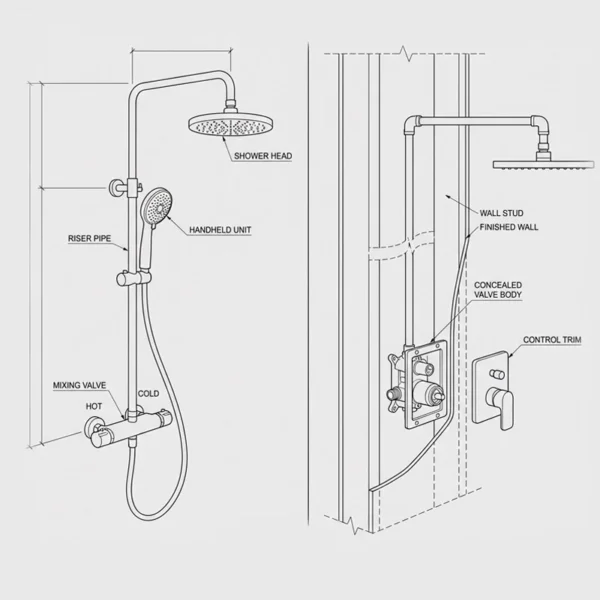
For a brand specifying shower systems across multiple SKUs or project types, the exposed/concealed decision affects more than how a bathroom looks on day one. It shapes warranty exposure, the labor cost of a service call five years into a product’s life, and how tightly installation has to be coordinated with plumbing, tiling, and waterproofing trades. Get the system type wrong for the application — a high-turnover hotel renovation, for example — and the cost shows up later as extended downtime and wall reconstruction, not as a line item anyone budgeted for up front.


Regulatory tightening on flow rate is only one part of the picture. Grand View Research’s market sizing shows continued growth in the fixture category even as basic showerhead flow rates are capped, which points to buyers paying for engineering and finish quality rather than raw water volume. Concealed systems, in particular, compete on a promise of minimalist aesthetics and precise temperature control rather than on flow rate alone — which is exactly why installation tolerance and internal flow-path design matter more for concealed shower faucets than for exposed ones.
Exposed shower faucets provide direct access to all functional components, including shower valves, cartridges, and diverters. Because everything is installed externally, maintenance work can typically be completed without disturbing the wall structure, and no restoration work is required after a part replacement.
Concealed systems place the critical components inside the wall cavity. Maintenance requires either a dedicated access panel or a partial wall opening, and wall restoration — tile replacement, waterproof layer repair — is often needed in addition to the mechanical repair itself. That difference is the single biggest driver of long-term service cost between the two system types.
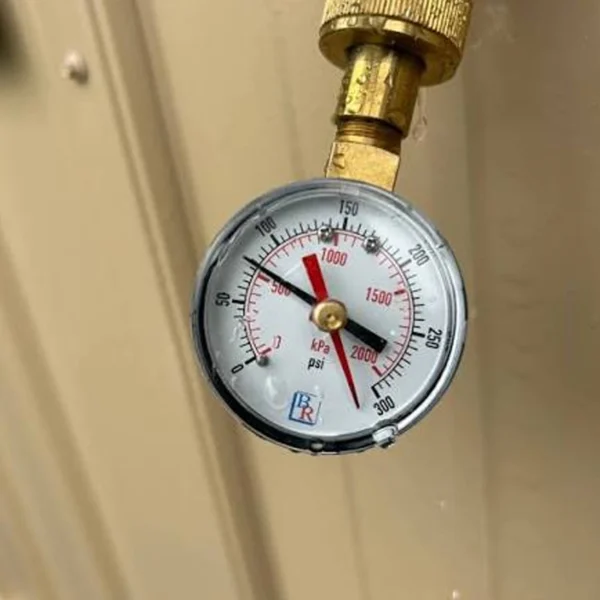
Exposed systems generally offer a more direct flow path with fewer internal fittings and shorter routing, which keeps hydraulic resistance low and flow performance relatively stable even when supply pressure fluctuates. With standard inlet pressure between 2.5 and 3.0 bar, pressure loss typically remains within 0.05 to 0.15 bar.
Concealed systems route water through longer internal paths within the wall structure. Additional fittings, directional changes, and extended pipe runs all add hydraulic resistance, which is why concealed systems are more sensitive to pressure loss — typically 0.15 to 0.35 bar, corresponding to a 15% to 35% reduction in flow efficiency in many real-world installations, particularly in low-pressure or multi-floor supply systems. This is the direct engineering consequence of the flow-rate compliance pressure described above: as allowable flow rates shrink, the margin for hydraulic loss inside a concealed system shrinks with it.
Exposed systems are more forgiving during installation. Minor deviations in pipe alignment or wall positioning can often be corrected using external fittings or adjustable connectors — an installation tolerance of roughly ±10 to 15 mm — which makes exposed systems well suited to retrofit projects with unpredictable existing conditions.
Concealed shower faucets require significantly tighter installation precision, because the valve body and outlet positions are fixed inside the wall before finishing. Alignment has to be right at the pre-installation, rough-in stage — the effective tolerance range is typically limited to ±2 to 3 mm, and any meaningful deviation can lead to misalignment of trim components or compromised sealing, which makes coordination between plumbing and finishing trades a real project-management factor, not just a technical detail.
In exposed systems, waterproofing is comparatively simple because most hydraulic connections stay outside the wall. Penetration points are limited, and any leak is generally visible early, which simplifies troubleshooting.
Concealed systems need a more deliberate waterproofing strategy, since multiple connection points sit hidden inside the wall structure. In field conditions, leakage on concealed systems is more commonly traced back to interface sealing or waterproofing-layer defects than to the valve body itself — and once a failure does occur, the repair typically involves both a plumbing fix and reconstruction of the affected wall layers.
Exposed systems have a comparatively linear cost structure, concentrated in the valve assembly and standard installation labor. Because maintenance rarely involves structural work, lifecycle costs stay predictable.
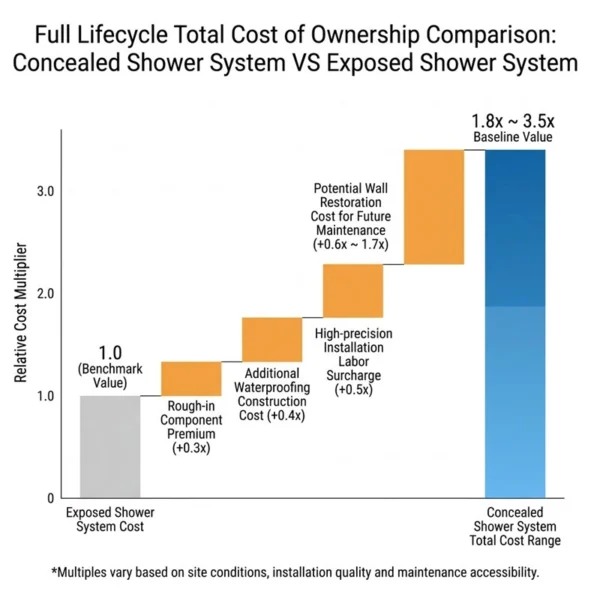
Concealed systems carry a layered cost structure: rough-in components, additional waterproofing work, tighter installation-precision requirements, and the possibility of restoration costs during future maintenance. Evaluated across a full lifecycle, total cost of ownership for concealed systems typically runs 1.8 to 3.5 times higher than exposed systems, depending on project conditions and installation quality.
The real difference between exposed and concealed systems isn’t appearance — it’s where system complexity lives. Exposed systems keep complexity outside the wall, which improves serviceability and reduces maintenance uncertainty. Concealed systems move that complexity into the wall structure, which improves visual integration but raises sensitivity to installation accuracy and long-term maintenance effort. Both remain sound engineering choices when matched to the right application through proper design and development.
In 2024, JEKARE supported a European bathroom brand — a mid-sized supplier (~100 employees, roughly 80,000–100,000 shower system sets sold annually across plumbing distributors, residential developers, and boutique hotel contractors) — through exactly this shift. Driven by demand for minimalist bathroom design, the customer’s product strategy had concentrated heavily on a single concealed shower system platform, applied across new construction, hospitality, and renovation projects alike. Expanding into renovation work is what surfaced the problem.
Installation feedback reviewed across three project categories, all originally using the same concealed system, told a clear story:
| Project Type | Volume | Installation Adjustment Requests | Installation Time Variation |
|---|---|---|---|
| New residential developments | 450 bathrooms | 4% | ±10 min |
| Boutique hotels | 180 bathrooms | (low, in line with new construction) | ±10 min range |
| Renovation apartments | 320 bathrooms | 18% | ±35 min |
Maintenance access concerns followed the same pattern — low on new construction, frequent on renovation.
JEKARE’s engineering review ruled out a product-quality explanation first: the concealed system performed as expected under controlled construction conditions. The real driver was project environment:
Rather than replacing concealed systems, JEKARE recommended splitting the product strategy by project type:
The customer adjusted its portfolio mix accordingly — from 85% concealed / 15% exposed to 55% concealed / 45% exposed — repositioning rather than replacing either system. Within the following sales cycle, renovation-channel inquiries increased roughly 30%, contractor installation complaints dropped 40%, and product recommendation accuracy improved across project types, backed by an internal selection guideline mapping customer segment to system type (hotel developers → concealed; new residential → concealed or hybrid; renovation contractors → exposed; maintenance-focused projects → exposed).
The generalizable point, consistent with the framework above: shower system selection is influenced less by product appearance than by installation environment, maintenance expectations, and project lifecycle cost. A concealed system isn’t automatically the better solution, and an exposed system isn’t simply the cheaper one — the correct choice depends on construction stage, installation tolerance, maintenance requirements, and target market expectations.
Before choosing between exposed and concealed shower faucet systems for a project, it’s worth working through a short set of questions rather than defaulting to whichever system looks more premium on paper:

The exposed/concealed decision is really the first link in a longer chain: system choice drives installation tolerance requirements, which drives how carefully an OEM partner needs to manage rough-in coordination, which in turn affects how confidently a brand can standardize a product line across different markets and project types.
Commercially, that means brands serving hospitality or new-construction channels have a reason to specify concealed systems where visual integration commands a premium, while brands serving renovation-heavy or maintenance-sensitive channels have a reason to standardize on exposed shower faucets to keep lifecycle cost predictable. Treating this as an engineering decision tied to project type — rather than a single default across a whole catalog — is what keeps warranty costs and customer satisfaction aligned as a product line scales into new markets.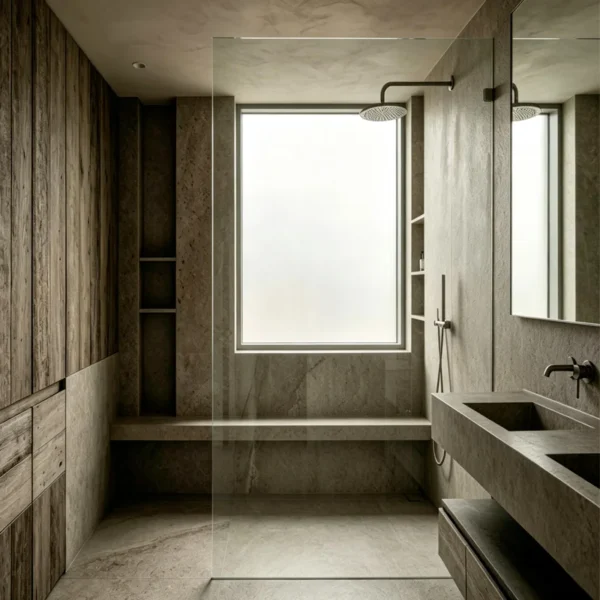
Yes. Many brands standardize on concealed systems for flagship or hospitality-facing SKUs and keep exposed systems for value-tier or renovation-focused lines, since the two serve different installation contexts rather than different quality tiers.
Generally yes — buildings with lower incoming pressure, such as upper floors of multi-story properties, are more exposed to the additional hydraulic loss inherent in concealed systems, which makes exposed or pressure-boosted concealed designs worth evaluating early rather than after installation.
Concealed systems typically involve more components (rough-in valve body, trim kit, wall box) that need to be coordinated and QC’d as a set through inspection, which can extend production and packing lead time compared to a single-unit exposed assembly.
Because concealed systems expose only the trim plate and controls, finish durability testing can focus on the visible trim; exposed systems require the entire visible assembly — valve body included — to hold up to daily handling and cleaning chemicals.
Yes — because concealed components sit inside a cavity with limited airflow, material and gasket selection has a bigger long-term impact on corrosion resistance than it does for exposed components exposed to normal bathroom ventilation.
Ask for the supplier’s documented rough-in tolerance range and how it’s verified during production — not just the marketing tolerance figure — since actual field tolerance depends on fixture design as much as installation skill.
Michael Zhang is a Bathroom Systems Application Engineer at JEKARE with experience in shower faucet products and installation systems. He specializes in product application, water flow performance, installation practices, and maintenance considerations. By working with both manufacturing and project teams, he helps develop practical bathroom solutions that meet the needs of distributors, contractors, and OEM customers.
1.Grand View Research — Shower Heads Market Size Report, 2025-2030
https://www.grandviewresearch.com/industry-analysis/shower-heads-market-report
2.U.S. EPA WaterSense — Showerheads Specification
https://www.epa.gov/watersense/showerheads
✔ 20+ Years of OEM & ODM Manufacturing Experience ✔ Complete Shower, Faucet and Bathroom Product Solutions ✔ Engineering Support from Design to Production ✔ Rough-In Tolerance and Hydraulic Testing Built Into Standard QC ✔ Flexible Customization for Different Markets ✔ Manufacturing Partner for Global Distributors and Brands
If your team is weighing exposed and concealed shower faucet specifications across different project types, it often helps to walk through installation tolerances and hydraulic requirements before finalizing a product line. JEKARE’s OEM/ODM project process works through these tradeoffs with OEM partners from initial specification through DFM review and production.