Call us: +86-18965139230 | Mail to us: info@jekare.com

The global faucet market was valued at USD 23.28 billion in 2024 and is projected to reach USD 36.69 billion by 2030, growing at a CAGR of 8.0%, according to Grand View Research. As the supplier base competing for this growth expands, product specification alone — base material, finish, cartridge type — has become less differentiating on its own, since most competent suppliers can list similar specs. What separates supplier quality in practice is often the production process behind those specs, not the specs themselves.
Brass and bronze materials accounted for a 39.9% revenue share of the faucet market in 2024, per the same Grand View Research analysis — meaning that for the large majority of the market, process quality specifically means casting, machining, and finishing process discipline applied to a copper alloy substrate, rather than a generic “manufacturing quality” claim that could apply to any material.

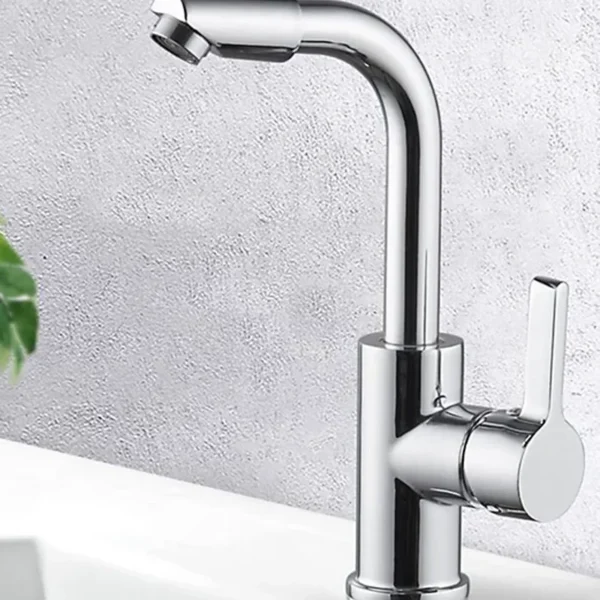
A kitchen faucet failure — a leaking cartridge seat, an inconsistent finish, a dimensional mismatch at assembly — usually traces back to variability at a specific production stage, not a design flaw. Buyers who evaluate only the finished product spec miss the process control questions that actually predict long-term reliability.
As sourcing relationships mature, brands increasingly move from accepting a supplier’s finished-product test report to asking process-level questions — how casting composition is verified, how machining tolerances are held, how plating consistency is maintained across production runs.
A kitchen faucet typically passes through casting, machining, surface finishing, and assembly before final testing — four distinct process stages, each with its own failure modes. A supplier strong at one stage isn’t automatically strong at all four, which is why single-point quality claims can be misleading.
Brass faucet bodies produced by sand casting are commonly evaluated against ASTM B584, the Standard Specification for Copper Alloy Sand Castings for General Applications, which establishes compositional requirements for the alloy elements used and requires mechanical property testing — tensile strength, yield strength, and elongation — to confirm the casting meets specification, rather than relying on visual inspection alone.
Notably, ASTM B584 specifically states that castings shall not be repaired, plugged, welded, or burned in — a specific, checkable requirement that directly addresses a known casting defect workaround. A supplier that patches porosity defects rather than rejecting the affected casting is operating outside this standard’s requirements, which makes this a concrete question buyers can ask during process evaluation rather than a vague “quality control” inquiry.
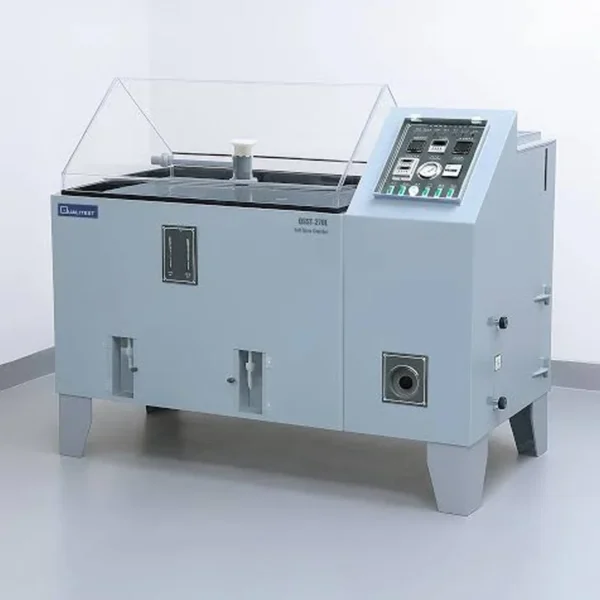
Regardless of whether a kitchen faucet is finished through electroplating or PVD coating, corrosion resistance is commonly evaluated using ASTM B117, the Standard Practice for Operating Salt Spray (Fog) Apparatus. Because this test method applies across finishing technologies, it gives buyers a consistent reference point for comparing finish durability claims across different suppliers and different production processes, rather than relying on process-specific marketing language.
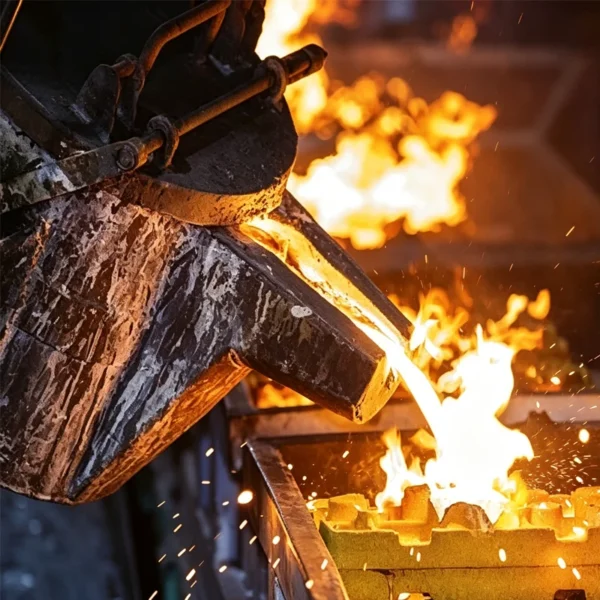
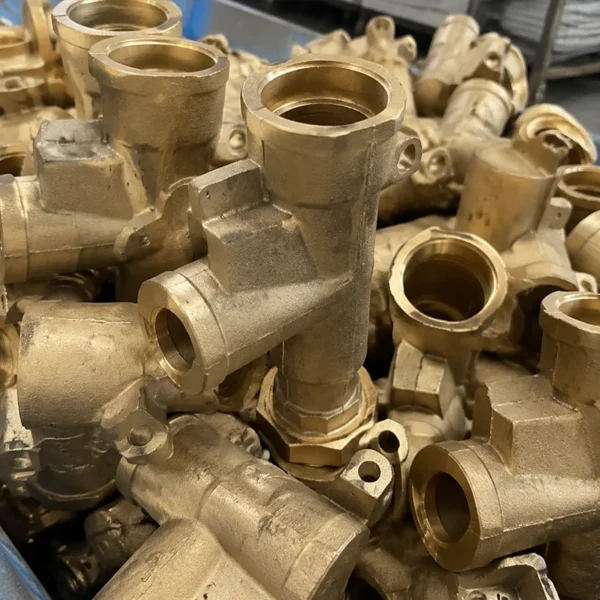
At JEKARE, our engineering team evaluates kitchen faucet projects from a manufacturing process perspective rather than only reviewing final product specifications. In OEM development discussions, one recurring focus is the gap between an approved sample and consistent mass production performance — particularly when products move from prototype validation into higher-volume manufacturing.
For kitchen faucets, the critical challenges are rarely limited to the selection of brass material, cartridge type, or surface finish alone. The production sequence behind these specifications — including casting stability, machining accuracy, finishing control, and assembly verification — determines whether the final product can maintain consistent performance across repeated production batches.
During supplier evaluation and product development discussions, engineering teams typically pay close attention to areas where small process variations can create downstream issues. For example, inconsistent casting conditions may affect machining stability, while insufficient dimensional control around cartridge seats or threaded connections can increase the risk of leakage during final assembly testing.
From a manufacturing standpoint, this is why JEKARE approaches kitchen faucet projects by reviewing the complete production chain rather than isolated components. A faucet body, cartridge system, and finished surface must function as one integrated assembly, and process control at each manufacturing stage directly influences long-term product reliability.
For brands developing or expanding faucet collections, evaluating the supplier’s ability to control each production stage provides a clearer indication of manufacturing capability than comparing specifications on a product sheet alone.
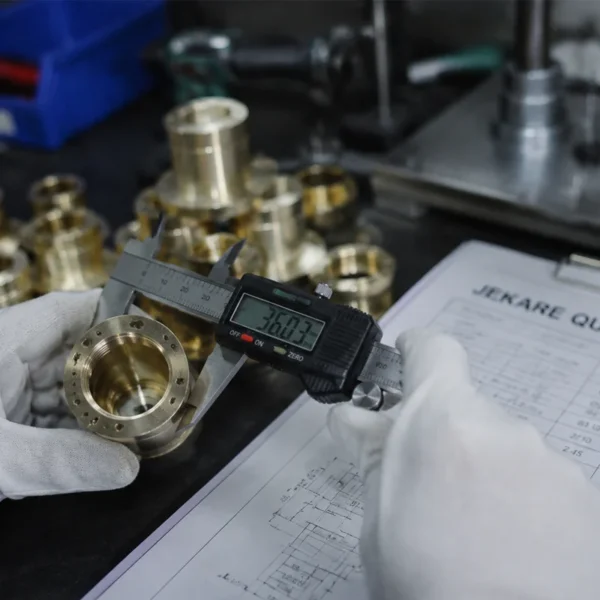
Request actual compositional test data referencing ASTM B584, and ask specifically whether the supplier repairs or rejects castings with porosity defects — a supplier’s answer to this question reveals more about actual process discipline than a general durability claim does.
Ask how dimensional tolerances are held and verified after casting — particularly at cartridge seats and threaded connections, where tight tolerances directly affect leak resistance and long-term function.
Request ASTM B117 salt spray test data for the specific finish being sourced, and ask how the supplier controls for batch-to-batch consistency in plating thickness and color, not just an initial sample approval.
Ask what testing occurs after assembly — water pressure testing, leak testing, cartridge cycle testing — and whether this is performed on a sampling basis or across full production runs, since sampling rates directly affect how much confidence a buyer should place in a supplier’s pass rate claims.
Understanding a supplier’s production process — not just their finished product specification sheet — connects directly to how confidently a brand can commit to a production order without discovering quality gaps after the fact. A brand that evaluates suppliers primarily on price and general spec compatibility, without verifying process-level discipline at each production stage, carries hidden execution risk that surfaces later as warranty claims or inconsistent reorders.
More broadly, as the faucet market continues to grow and attract more competing suppliers, process transparency is becoming a genuine differentiator brands can use in their own conversations with retail and hospitality customers — being able to describe a supplier’s actual casting, machining, and testing process in specific terms carries more weight than a general quality assurance statement.
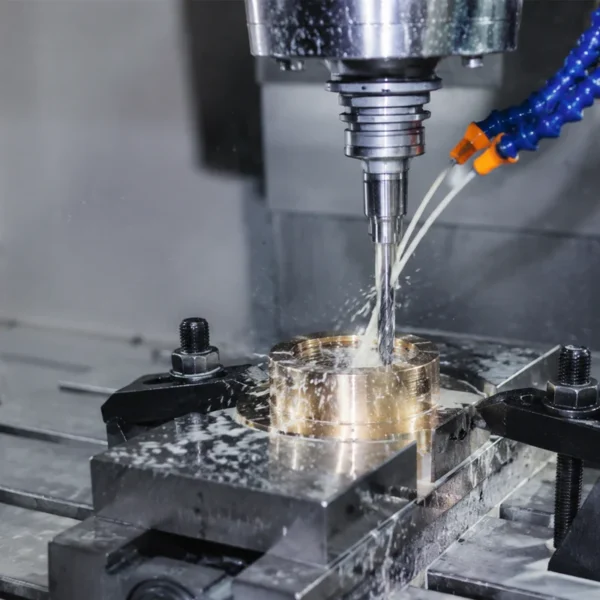

JEKARE’s single-handle hot-and-cold kitchen faucet moves through in-house die casting, CNC machining, and surface finishing within a single facility — a setup that keeps each process stage under direct process control rather than distributed across multiple subcontracted vendors, which is directly relevant to the casting composition, tolerance, and finish consistency questions buyers evaluate during supplier qualification.
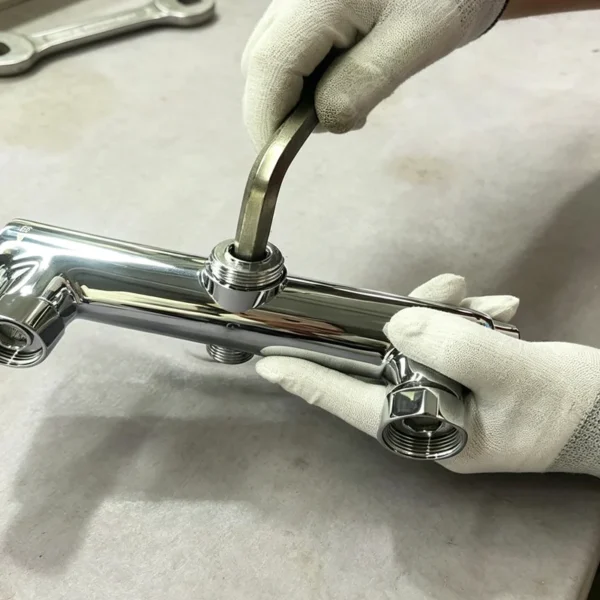
Beyond casting and finishing, JEKARE’s quality inspection process evaluates cartridge function, leak testing, and assembly integrity as part of standard product qualification for the broader faucet product line — addressing the final-stage testing questions that determine whether upstream process quality actually translates into a reliable finished product.
Kitchen faucet quality is a function of production process discipline at each of several distinct manufacturing stages — casting composition and defect handling, machining tolerance control, finish consistency, and final assembly testing — not a single finished-product specification. For B2B buyers, the practical takeaway is to evaluate a manufacturing partner against named, verifiable standards like ASTM B584 and ASTM B117 at the process level, rather than accepting a general quality claim that doesn’t distinguish between suppliers with genuinely different process discipline.
Neither is universally superior — die casting generally supports higher production volumes with tighter dimensional consistency, while sand casting is often used for lower-volume or more complex geometries; the better choice depends on the specific product design and production volume rather than one process being categorically better.
This is difficult to verify from a finished product alone — the most reliable approach is to ask directly during a factory audit or process review and request documentation of the supplier’s defect handling procedure, since a repaired casting can be visually indistinguishable from a compliant one after finishing.
Generally yes for corrosion resistance specifically, but salt spray testing is an accelerated laboratory simulation and doesn’t capture every real-world factor like mechanical wear or water chemistry variation — it’s a useful comparative benchmark rather than a complete durability guarantee on its own.
There’s no single universal standard — some manufacturers test 100% of units for leak and pressure performance while others use statistical sampling; buyers should confirm which approach a specific supplier uses and weigh that against the production volume and application criticality of their specific order.
Not automatically — a subcontracted specialist with deep expertise in a single process stage (such as a dedicated plating house) can sometimes outperform a generalist in-house process, but in-house production generally offers easier process traceability and coordination across stages, which matters more as the number of production stages increases.
Jenny is a Manufacturing Engineer at JEKARE with over 20 years of experience in bathroom and kitchen fixture development and OEM manufacturing. She specializes in casting process control, CNC machining tolerance verification, and multi-stage production quality across faucet product lines. With extensive experience supporting global bathroom and kitchen brands and distributors through supplier qualification and process auditing, Jenny focuses on helping buyers evaluate production process discipline at each manufacturing stage, rather than relying on a single finished-product quality claim.

1. Grand View Research — Faucet Market Size, Share & Trends Analysis Report
https://www.grandviewresearch.com/industry-analysis/faucet-market
2. ASTM International — B584: Standard Specification for Copper Alloy Sand Castings for General Applications
https://www.astm.org/Standards/B584.htm
3. ASTM International — B117-19: Standard Practice for Operating Salt Spray (Fog) Apparatus
https://store.astm.org/b0117-19.html