Call us: +86-18965139230 | Mail to us: info@jekare.com

Faucet flow rate has been federally regulated in the U.S. since the Energy Policy Act of 1992, which originally capped both lavatory and kitchen faucets at 2.5 GPM. In 1994, ASME A112.18.1—the national plumbing supply fittings standard—tightened the lavatory faucet limit to 2.2 GPM at 60 psi, a figure the U.S. Department of Energy later adopted as the uniform federal ceiling for all faucets.
The EPA WaterSense program, launched in 2007, went further: a WaterSense-labeled bathroom faucet must not exceed 1.5 GPM at 60 psi, with many current models certified down to 1.0–1.2 GPM. EPA has since proposed lowering the WaterSense ceiling again, to 1.2 or 1.0 GPM, reflecting how far the regulatory floor has already moved in less than two decades.
What regulation does not standardize, however, is geometry. Flow rate is measured and certified under fixed lab conditions; spout reach, spout height, and their interaction with a specific basin are not covered by ASME A112.18.1 or the WaterSense specification. That gap is where most real-world faucet performance complaints originate—not from non-compliant flow rates, but from a mismatch between a compliant faucet and the sink it was installed on.
For OEM buyers, a faucet that passes flow-rate certification can still generate a high rate of installation complaints if spout geometry was not engineered against the sink program it ships with.
Splash-related complaints translate into concrete costs: increased installer callbacks, higher return rates on private-label programs, and—in hospitality and multi-unit residential projects—guest or tenant complaints that affect a property’s own service metrics rather than just the fixture’s. Because spout reach and height decisions are made once at the tooling stage, a mismatch discovered after mass production is expensive to correct; it typically requires re-tooling or a full aerator redesign rather than a simple field fix.
This is why spout reach, height, and flow rate should be treated as a single specification decision tied to the sink program, not as three independent line items chosen for visual proportion.
Two data points anchor this discussion in verified regulatory fact:
For OEM buyers, this means a flow-rate spec written for one market can already be non-compliant, or at least non-competitive, in another—independent of whether the faucet’s spout geometry has been validated at all.
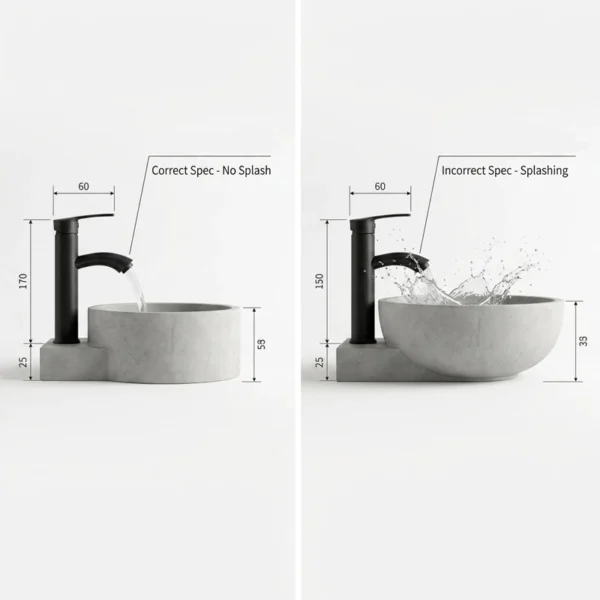
On a prior single-handle faucet program, a North American bathroom brand initially attributed an elevated warranty return rate to plating quality, after returned units showed discoloration around the outlet. Component-level failure analysis found the coating itself passed the required corrosion evaluation. The larger share of returns—58% of the sampled units—traced back to internal components instead: ceramic cartridge sealing that became inconsistent after repeated cycling, and an aerator originally optimized only for flow-rate compliance, which lost flow stability once installed in higher-mineral-content water.
Following aerator and cartridge specification updates—including cycling validation and flow consistency testing under varied pressure—the customer’s warranty return rate for that product line dropped by approximately 35%.
The relevant lesson for spout and aerator selection: a component that passes flow-rate certification in a lab is not automatically validated for the water conditions or basin geometry it will actually face in the field. Aerator material and structure need to be evaluated against installation conditions, not only against the GPM number on the compliance label.
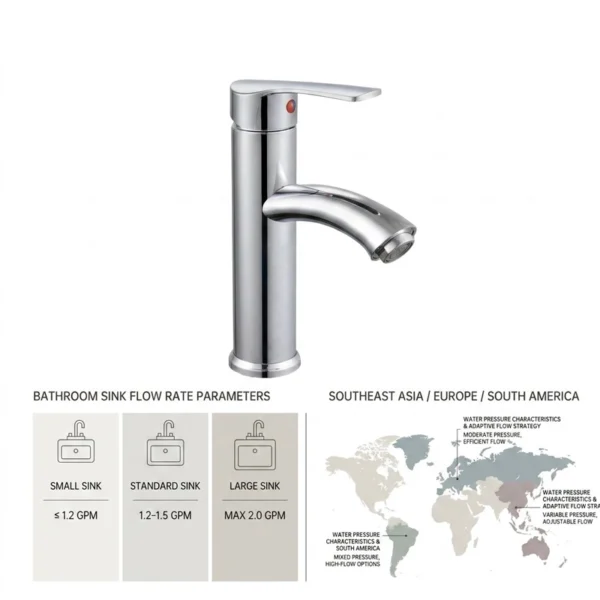
The dimensional ranges below are JEKARE’s internal engineering reference values, developed from OEM project experience—they are not published industry standards, and should be validated against each specific basin program rather than applied as a universal rule.
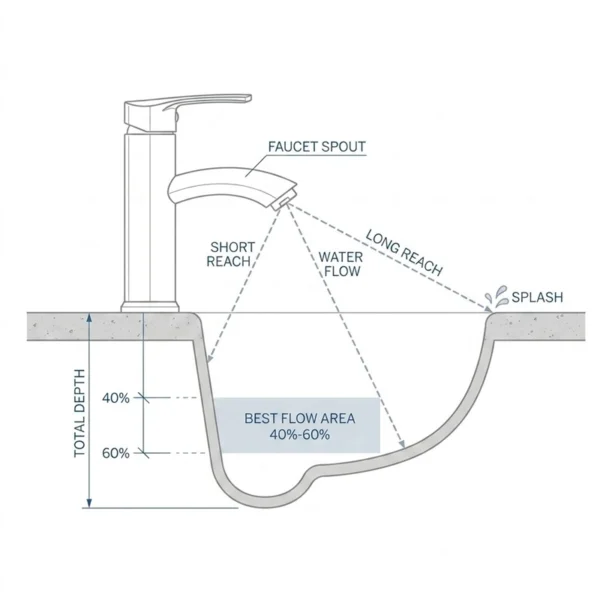
Water impact position. In JEKARE’s engineering reference range, the target impact zone sits at approximately 40–60% of basin depth measured from the rear wall. Reach that lands short of this range tends to rebound off the rear wall; reach that overshoots it pushes the stream toward the front edge and raises overflow risk.
Spout reach by basin depth (JEKARE internal reference, not an industry standard):
Spout height by basin type (JEKARE internal reference):
Height should never be adjusted independently of flow rate and aerator design—raising spout height without recalibrating the other two increases impact energy and splash risk even when reach is correct.
Flow rate, unlike reach and height, has a real regulatory anchor rather than an internal reference range: WaterSense compliance requires ≤1.5 GPM at 60 psi (many current models ≤1.2 GPM), and federal baseline compliance sits at ≤2.2 GPM at 60 psi. Within that regulatory ceiling, JEKARE’s internal engineering guidance is to keep small basins at or below 1.2 GPM, standard basins in the 1.2–1.5 GPM range, and large basins up to 2.0 GPM where depth allows—shallow basins in particular benefit from trimming reach by roughly 10% below the standard reference range to reduce splash without affecting usability.
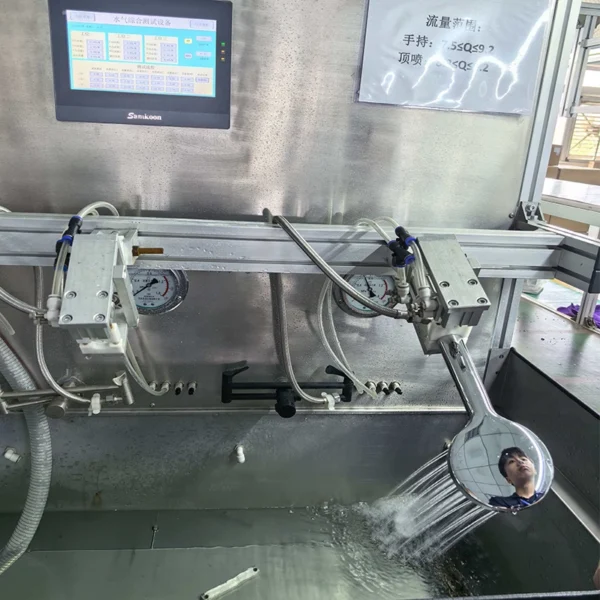
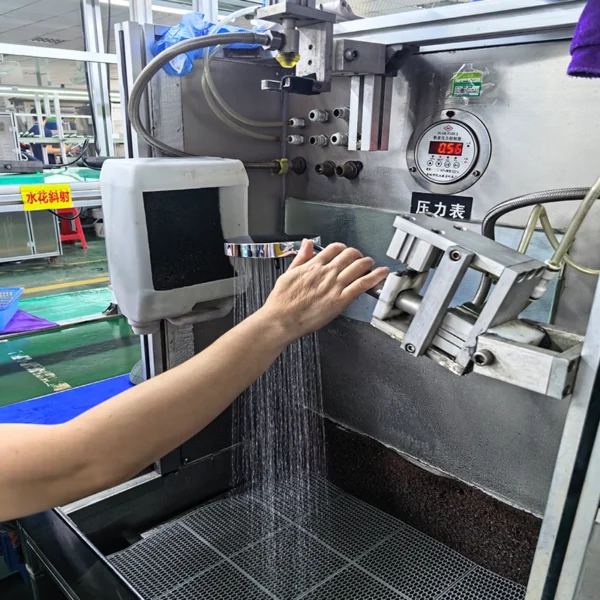
Before approving a faucet program for a specific sink line, OEM buyers should confirm:
First, has spout reach been validated against actual basin depth and internal contour—not basin width, and not visual proportion alone?
Second, does the flow rate meet the target market’s actual regulatory ceiling, including any state- or country-level requirements stricter than the federal baseline?
Third, has the aerator been evaluated against the installation region’s water hardness, not only against lab-condition flow compliance?
Fourth, have height, flow, and aeration been tested together as a system, rather than approved as three separately compliant specifications?
Fifth, has the combination been verified under low-pressure conditions as well as standard test pressure, since splash and stream stability often diverge at the lower end of the pressure range?
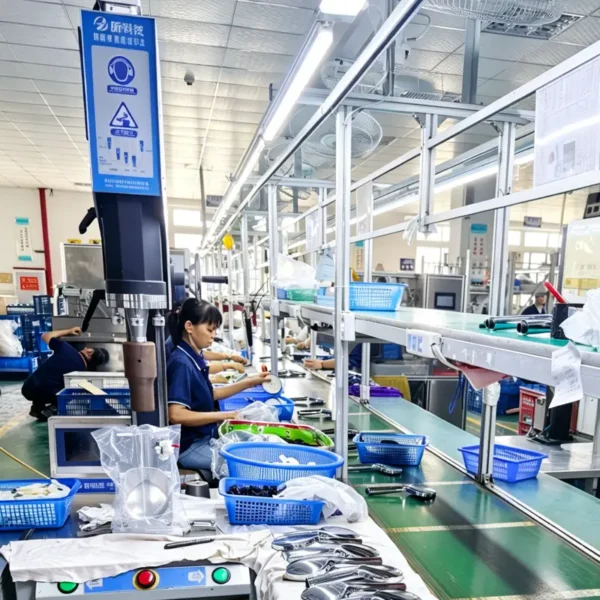
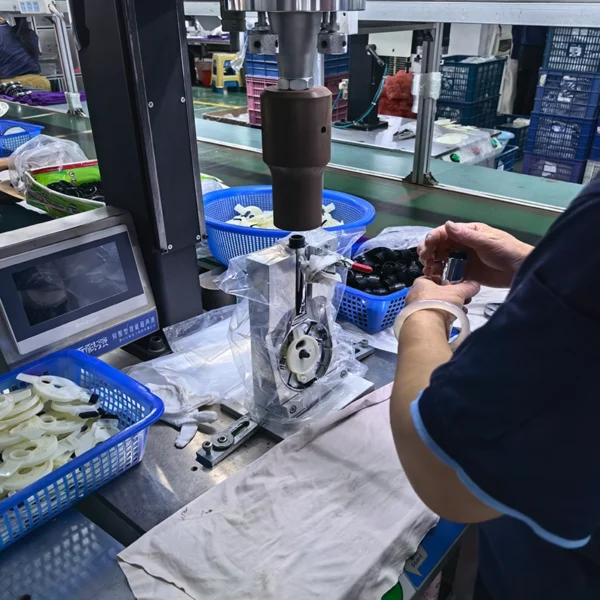
Faucet-sink geometry is easy to treat as a cosmetic decision because it doesn’t show up on a compliance certificate. In practice, it is one of the more common sources of post-launch complaints precisely because it sits outside what flow-rate certification tests for.
For brands running faucet programs across multiple sink lines or multiple regions, building spout reach, height, and aeration into the same specification review as flow-rate compliance—rather than treating them as a downstream tooling detail—reduces the installer callbacks and return-rate risk that otherwise surface only after a program is already in the field.
1. What is the correct way to match faucet size to sink size?
Match spout reach and height to basin depth and internal contour, not basin width. In OEM production, this also means confirming tooling tolerance holds spout position consistently across batches—an out-of-spec cavity can shift impact position even when the nominal design is correct.
2. What is the ideal faucet spout reach for bathroom sinks?
As an internal engineering reference, JEKARE typically works within 3–4″ for small basins, 4–5″ for standard basins, and 5–7″ for large basins, with double-basin systems requiring independent alignment per basin rather than a single shared reach spec.
3. Why does my faucet splash so much?
Usually incorrect spout reach, excessive height relative to basin depth, or an aerator not matched to the installation’s water pressure or hardness. This is why splash issues are best caught during pre-production verification testing rather than diagnosed after installation complaints arrive.
4. How does faucet height affect water performance?
Greater height increases impact energy at the basin surface, raising splash risk unless flow rate and aeration are recalibrated together—height should never be specified as an isolated design choice.
5. What is the best flow rate for bathroom faucets?
WaterSense certification requires ≤1.5 GPM at 60 psi, with many labeled models at 1.0–1.2 GPM; federal baseline compliance allows up to 2.2 GPM. Several U.S. states already restrict sales above 1.2 GPM, so the applicable ceiling depends on the target market, not a single global number.
6. Does a faucet-sink mismatch affect regulatory compliance?
Not directly—flow-rate certification and spout geometry are tested separately, and a faucet can be fully WaterSense- or ASME-compliant while still splashing on a mismatched basin. That’s precisely why compliance testing alone isn’t sufficient evidence that a faucet program is ready for a specific sink line.
Emily Chen is a Product Specialist at JEKARE, focusing on bathroom product development, faucet engineering, and water control technologies. With experience supporting OEM faucet and shower programs for global bathroom brands, she works on translating installation-condition data—flow rate, pressure range, and basin geometry—into manufacturable product specifications, from early DFM review through production validation.
Matching spout reach, height, and flow rate to a specific basin program is a specification decision, not a finishing detail—and it’s easiest to correct before tooling, not after installation complaints start.
JEKARE supports OEM faucet development with engineering review and DFM, precision manufacturing, and pre-production verification testing across sink faucet and kitchen faucet programs.
If you’re developing a new faucet line or extending an existing one across sink programs or regions, our engineering team can review reach, height, flow, and aeration together before mass production begins.