Call us: +86-18965139230 | Mail to us: info@jekare.com

A bathroom brand developing a product for a hard-water, coastal-exposure market approached JEKARE with a concept technical package rather than a finished design — a common starting point for an OEM RFQ, and a useful one to walk through because it shows what a well-structured brief actually contains.
The brief called for a compact, wall-mounted fixed shower head — deliberately small in diameter to signal water efficiency — with no electronics, sensors, or battery components. The connection was specified as a G1/2 BSPP thread per ISO 228-1, a standard fitting rather than a proprietary one, which matters for compatibility with existing plumbing in the target market.
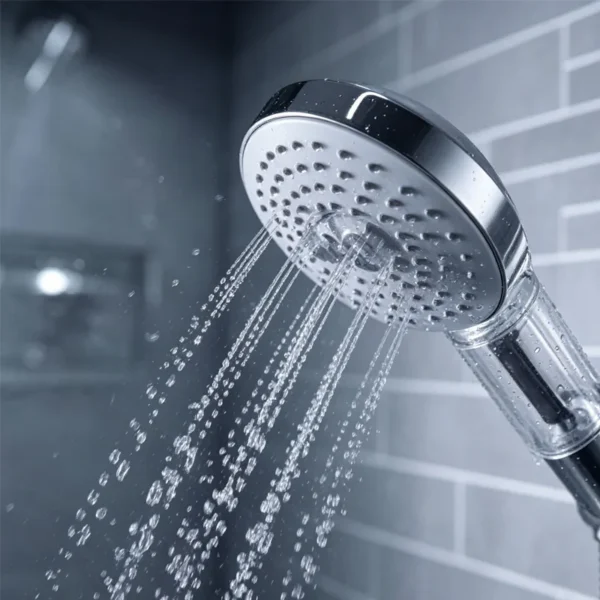
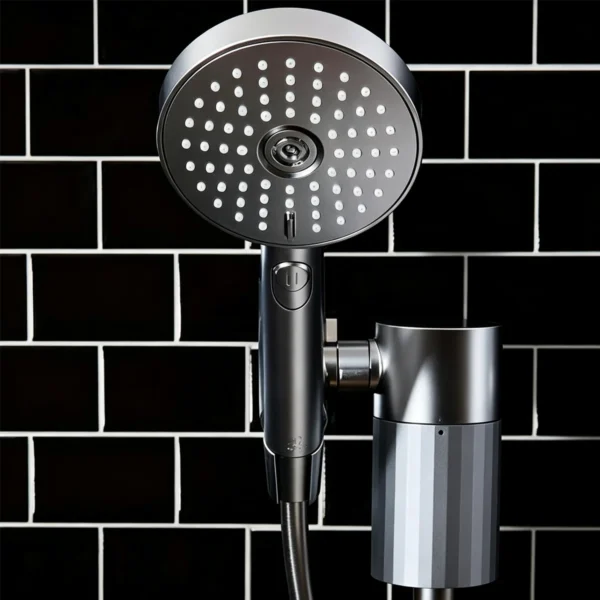
Several requirements in the brief existed only because of the target market’s water conditions: a removable inlet screen for sediment (with an explicit note that it does not remove dissolved mineral hardness — an important distinction the buyer wanted stated accurately, not oversold), flexible silicone outlet nozzles designed to be rubbed clean of scale buildup, and a documented cleaning procedure using citric acid rather than harsh chemicals.
Because the target market includes coastal environments, the brief specified corrosion-resistant materials throughout — stainless steel accents rather than exposed brass or zinc-plated steel, and peroxide-cured seal material compatible with hot, chlorinated water — along with a defined salt spray test duration to validate the finish before approval.
A shower head developed for a temperate, soft-water market doesn’t automatically translate to a hard-water, coastal one — the brief in this case reflected that directly. Regulatory context matters too: the buyer’s target market references a national standard for shower heads (Mexico’s NOM-008-CONAGUA-1998 , currently under a modification process per the government’s standards program), separate from voluntary programs like the EPA’s WaterSense specification that shapes flow-rate expectations in other markets. A brand sourcing across multiple regions needs to treat each market’s compliance path as a distinct requirement, not a variation on one universal spec.
Our review started with the same question any DFM review should start with: which requirements are dimensional targets, and which are performance requirements that need to be demonstrated through testing rather than assumed from a drawing. The brief itself was structured this way — distinguishing between mandatory dimensions that can’t change without approval, target values that need test evidence, and preliminary values to be resolved during prototyping. That structure made the DFM conversation more productive, because it was clear from the outset which numbers were fixed and which were still open for engineering input.
Material selection followed directly from the water-condition requirements rather than being chosen generically: a self-cleaning elastomer for the outlet nozzles, a compression-rated seal material suited to hot water exposure, and a corrosion-resistant metal finish for any exposed hardware — each tied to a specific requirement in the brief rather than a default material choice.
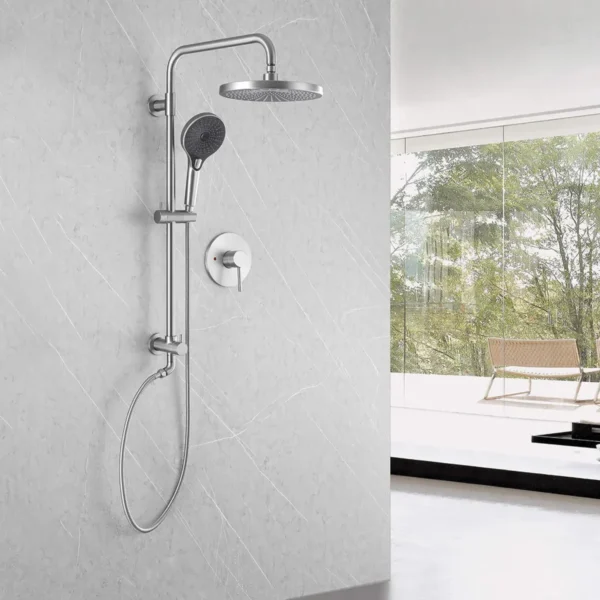
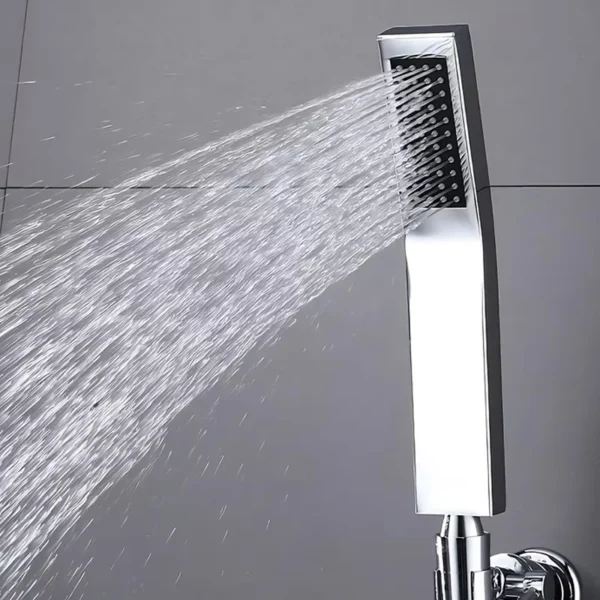
For a project like this, the sequence runs from RFQ review and initial DFM through hydraulic modeling, functional prototyping, flow-bench testing at multiple pressures, an accelerated hard-water exposure test, a beta prototype in near-production materials, tooling sample validation, and a pilot run before mass production is approved — with the buyer retaining sign-off at each stage rather than tooling proceeding on assumption. Flow performance, spray pattern, and hard-water cleanability are validated through physical testing at this stage, not projected from the drawing alone, which is standard practice for a product where the performance claim (water efficiency, scale resistance) is central to how it will be marketed.
Buyers developing products for hard-water or coastal markets specifically should expect the RFQ and DFM stage to take longer than a standard product, because performance claims tied to water conditions need to be demonstrated through testing — accelerated hard-water exposure, salt spray duration, cleanability after mineral buildup — rather than inferred from material specs alone. A buyer who treats these tests as a late-stage formality risks discovering a limescale or corrosion issue after tooling is already committed, which is a far more expensive place to find it than during prototyping.
This project is currently in the RFQ and DFM stage — CAD, test data, and a signed golden sample are still pending buyer approval, and no tooling has been released. This case study describes the engineering approach used to evaluate the brief, not a completed product launch; we’ll look to share development milestones as the project progresses, with the client’s agreement.
No — a mesh or sediment screen filters particulate matter like sand and scale flakes, but it does not remove dissolved mineral hardness; a product claiming to “soften” water through a screen alone would be overstating what the component does.
Coastal environments introduce airborne salt exposure even for indoor fixtures near the coast, particularly in bathrooms with ventilation to the outside — a defined salt spray test duration gives the buyer a measurable corrosion-resistance benchmark rather than a general durability claim.
A mandatory dimension can’t change without the buyer’s written approval and must be quoted as-is; a target dimension is a performance goal the supplier needs to demonstrate through test evidence, giving some engineering flexibility as long as the underlying performance requirement is met.
If a product is marketed for hard-water use, its seals, housing, and finish need to tolerate the descaling method the end user will actually use — specifying and testing against that cleaning method avoids a mismatch between the marketing claim and real-world durability.
It varies by project, but expect it to run longer than a standard product line, since accelerated hard-water and salt spray testing both require dedicated test cycles that can’t be compressed without weakening the validation.
Lily, Product Development Engineer, JEKARE
Lily has 20 years of experience in shower system product development, with a focus on translating RFQ and DFM requirements — hydraulic performance, hard-water durability, and corrosion resistance — into manufacturable designs for global bathroom brands and distributors.
At JEKARE, Lily works with international bathroom brands through the RFQ, DFM, and prototype validation stages, supported by the company’s 20+ years of OEM/ODM manufacturing experience and in-house testing capability across flow, hard-water exposure, and salt spray protocols.
1. Mexico NOM Standards Catalog — NOM-008-CONAGUA-1998
https://platiica.economia.gob.mx/normalizacion/nom-008-conagua-1998/
2. Diario Oficial de la Federación — Mexico 2026 Standards Program
https://dof.gob.mx/nota_detalle_popup.php?codigo=5780781
3. U.S. EPA — WaterSense Showerheads Program
https://www.epa.gov/watersense/showerheads
If you’re developing a shower head or bathroom fixture for a hard-water, coastal, or otherwise demanding water-condition market, moving forward usually starts with a few concrete steps:
Our team can walk through any of these with you based on where your project currently stands.