Call us: +86-18965139230 | Mail to us: info@jekare.com

The federal maximum flow rate for showerheads — 2.5 gallons per minute (gpm) at 80 psi — was established by the Energy Policy Act of 1992 and remains the current national ceiling, according to the Appliance Standards Awareness Project. What’s changed repeatedly since then isn’t the federal number itself, but the definition of what counts as “a showerhead” for compliance purposes, and which markets are allowed to set stricter limits.
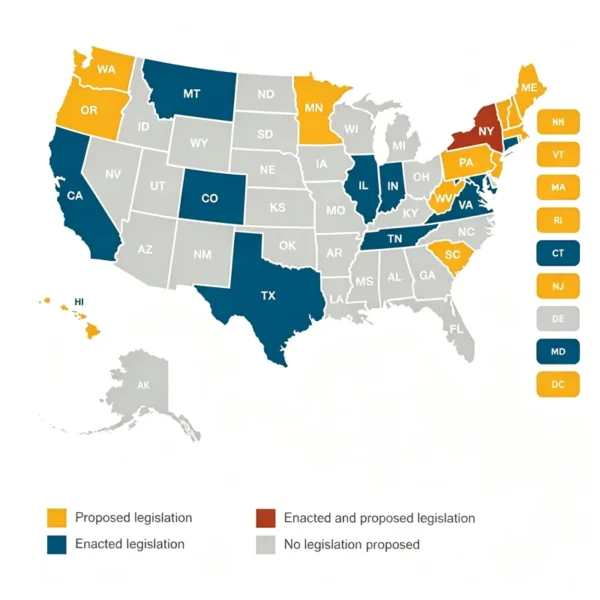
In December 2010, the U.S. Department of Energy officially waived federal preemption of the national showerhead standard, allowing individual states to adopt stricter requirements. As of 2024, 14 states had adopted showerhead standards more stringent than the federal baseline — meaning “the U.S. standard” has functioned as a patchwork for over a decade, not a single national figure.
For a B2B buyer, treating “2.5 gpm” as the complete answer to a compliance question is a genuine sourcing risk — a product compliant federally can still be non-compliant in California, Colorado, New York, Washington, or any of the other states with stricter limits, depending on where it’s actually sold.
Whether a multi-nozzle shower system’s flow rate is measured per-nozzle or as a combined total has been a genuinely contested regulatory question in recent years — and the answer materially affects whether a given product design is compliant, independent of the individual nozzle specifications.
With federal legislation actively moving through Congress on this exact question, a compliance answer that’s accurate today could be outdated within months — which means brands sourcing shower products need to track regulatory status as an ongoing part of supplier management, not a one-time spec confirmation.
Beyond the mandatory 2.5 gpm federal maximum, the EPA’s voluntary WaterSense label requires certified showerheads to demonstrate a maximum of 2.0 gpm while still meeting spray force and coverage performance criteria — giving buyers two distinct federal-level benchmarks, one mandatory and one voluntary, that shouldn’t be conflated.
California and Hawaii currently cap showerhead flow at 1.8 gpm, while Colorado, New York, and Washington cap it at 2.0 gpm, per the same regulatory tracking cited above — meaning a national product line shipping into these markets needs to be engineered to the strictest applicable limit for each specific destination, not a single nationwide spec.
On January 13, 2026, the U.S. House of Representatives passed H.R. 4593, the SHOWER Act, by a vote of 226–197. The bill would codify the ASME A112.18.1-2024 industry-standard definition of “showerhead” into federal law and, per the Congressional Record, would allow the 2.5 gpm maximum to apply to each individual nozzle in a shower system rather than the combined system output — reversing the aggregation interpretation used under the prior administration. As of this writing, the bill has passed the House and awaits Senate consideration; it is not yet law, and the Department of Energy would have 180 days after enactment to update its regulations accordingly if it passes.

Over the past several years, our engineering team has worked with global bathroom brands and distributors developing shower products for North American markets where flow-rate requirements vary significantly by state and product category.
One recurring challenge we see from B2B buyers is that many product specifications are finalized around a single flow-rate number — such as 2.5 GPM or 2.0 GPM — without first confirming which regulatory benchmark applies to the actual destination market. This often creates additional engineering adjustments later, especially when products are expanded from one region into multiple U.S. states with different mandatory limits.
For multi-function and multi-nozzle shower systems, the challenge becomes more complex because compliance depends not only on the total flow rate, but also on how the system configuration is evaluated — including nozzle quantity, spray function combination, pressure conditions, and the applicable measurement interpretation.
During the product development stage, JEKARE works with OEM partners to review these requirements before tooling and mass production. Through DFM analysis, flow-rate validation, and configuration optimization, our engineering team helps brands define the correct product specifications early, reducing the risk of redesign, certification delays, and market-specific compliance issues after production begins.
A key lesson from these projects is that flow-rate compliance should be treated as a product development requirement, not only a certification step. The most reliable shower programs are those designed around the target markets first, with testing data and manufacturing capability aligned from the beginning.
Build a market-specific compliance list rather than assuming a single federal spec covers a national product line — a product compliant in most states can still be non-compliant in California, Colorado, New York, Washington, or Hawaii specifically.
For any multi-nozzle or multi-function shower system, ask a manufacturer directly which measurement approach the current flow-rate spec assumes, and confirm this matches the current regulatory interpretation for your target market rather than an outdated assumption.
Since H.R. 4593 has passed the House but not the Senate, treat its provisions as a likely-but-not-certain future state, and confirm with your manufacturing partner how a product spec would need to adjust if the bill does or doesn’t become law.
Ask for flow-rate test data referencing the specific standard being claimed — federal 2.5 gpm, WaterSense 2.0 gpm, or a specific state’s tighter limit — rather than a general “water-efficient” assurance that doesn’t specify which benchmark it’s measured against.

Because U.S. shower flow-rate compliance is genuinely a market-by-market question rather than a single national answer, brands selling nationally need a compliance matrix mapped to actual distribution footprint, not a single product spec assumed to work everywhere. This becomes more consequential, not less, as pending federal legislation adds a layer of near-term uncertainty on top of an already fragmented state landscape.
More broadly, brands that build the operational habit of tracking regulatory status as an ongoing part of supplier management — rather than treating compliance as a one-time confirmation at product launch — are better positioned to adjust quickly if the SHOWER Act’s Senate outcome changes the federal baseline again in the coming months.
JEKARE’s shower product line is developed with flow-rate testing documented against specific benchmarks — federal, WaterSense, and stricter state-level limits — rather than a single generic “low-flow” claim, addressing directly the market-by-market compliance question B2B buyers actually need answered.
At least four specific advantages worth weighing when sourcing under this fragmented regulatory landscape: first, custom rain shower head programs that can be engineered to a specific state’s stricter flow limit without redesigning the entire product; second, quality inspection that documents flow-rate performance at multiple pressure points rather than a single test condition; third, direct engineering coordination through JEKARE’s OEM/ODM project process to confirm per-nozzle versus aggregate flow measurement for multi-function shower systems; and fourth, the ability to adjust product specifications as regulatory interpretation shifts, rather than being locked into a single fixed design across all markets.
There isn’t a single “U.S. shower GPM standard” — there’s a federal floor of 2.5 gpm, a voluntary WaterSense ceiling of 2.0 gpm, a patchwork of stricter state limits down to 1.8 gpm, and, as of early 2026, pending federal legislation that could change how multi-nozzle systems are measured going forward. For B2B buyers, the practical takeaway is to treat GPM compliance as an ongoing, market-specific tracking exercise rather than a fixed number to confirm once and forget, particularly while the SHOWER Act’s Senate outcome remains undecided.
This depends on the specific product — a multi-nozzle system currently designed to stay under a combined 2.5 gpm limit would likely remain compliant under a per-nozzle standard, since per-nozzle measurement is generally a less restrictive interpretation, but this should be confirmed against the final enacted text if the bill passes.
No — WaterSense’s 2.0 gpm is a voluntary labeling standard, not a legal exemption from stricter state requirements; a product must still comply with the applicable state’s mandatory limit regardless of WaterSense certification status.
Yes, some municipalities have adopted their own stricter local requirements beyond their state’s standard, which means a full compliance check should include local plumbing code review, not just state-level requirements, for products sold into specific metro markets.
The bill itself gives the Department of Energy 180 days after enactment to update federal regulations accordingly — actual production adjustment timelines for a specific manufacturer would depend on how much a given product’s current spec already aligns with the revised definition.
Yes — the flow-rate requirements apply to products sold into these markets regardless of where they’re manufactured, so an overseas manufacturing partner needs to design and test to the same state-specific and federal requirements as a domestic one.
Susan is a Senior Shower Systems Engineer at JEKARE with over 20 years of experience in bathroom fixture development and OEM manufacturing. She specializes in flow-rate engineering, multi-standard compliance testing, and regulatory tracking across shower system product lines. With extensive experience supporting global bathroom brands and distributors through multi-market product qualification, Susan focuses on helping buyers navigate the fragmented U.S. flow-rate landscape without assuming a single national spec covers every target market.