Call us: +86-18965139230 | Mail to us: info@jekare.com

Water damage and freezing isn’t a minor line item in U.S. homeowners insurance data — it’s a consistent top-two cause of claims. According to the Insurance Information Institute (Triple-I), about one in 60 insured homes files a property-damage claim caused by water damage or freezing each year, and separate Triple-I reporting puts water damage and freezing at roughly 22–24% of all homeowners insurance claims in recent years — second only to wind and hail. The U.S. Department of Energy publishes regional frozen-pipe probability data specifically because exposure varies so much by climate and by where pipes and fixtures sit relative to a building’s heated envelope — which is exactly the variable frost-free faucet design is built to control.
A frost-free faucet (also called a frost-proof hose bib or sillcock) is engineered with an extended stem and internal shut-off valve specifically to eliminate the standing water that causes freeze damage at its source, rather than relying on a homeowner to drain and insulate the fixture every winter.
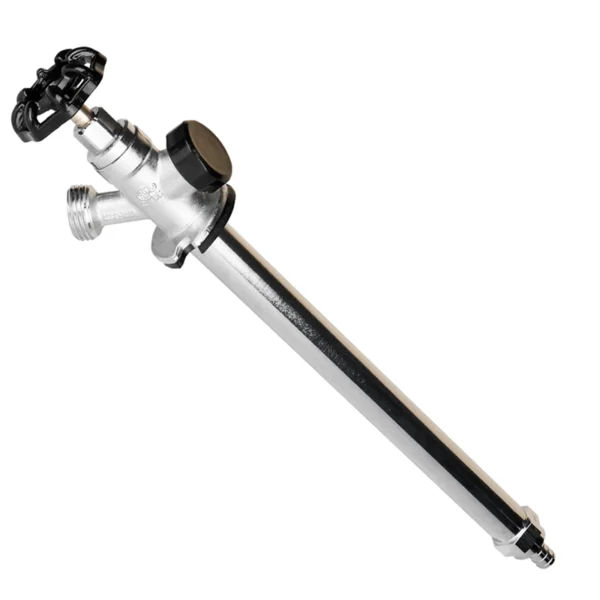
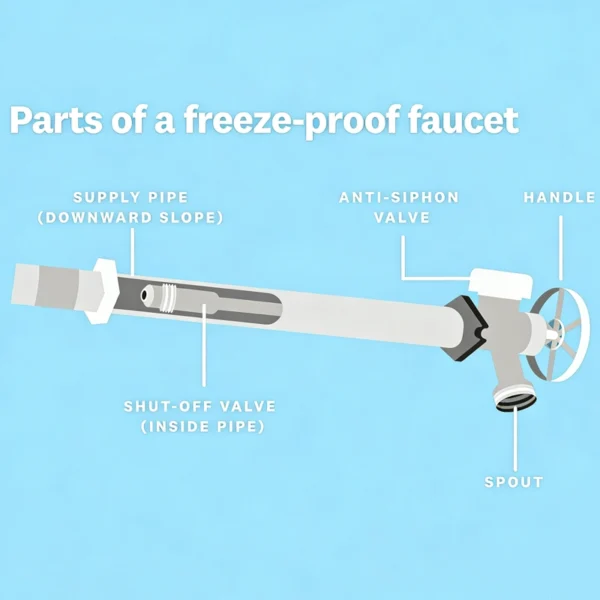
In the U.S., indoor valves are “faucets,” while outdoor valves are “spigots,” “hose bibs,” or “sillcocks.” In other English-speaking countries, indoor valves are “taps,” and outdoor valves may be called “plugs,” “pipes,” or “hose bibs.” A frost-free faucet is an evolution of the compression-style faucet specifically optimized for freeze prevention, featuring a long stem, internal shut-off valve, and self-draining design.
The principle is simple: no standing water, no freezing. The extended supply pipe carries the stem at least 4 inches into the warm interior, keeping the shut-off valve and water supply above the frost line. The internal shut-off valve, located inside, stays in a temperature-controlled environment along with the rear piping. The self-draining spout slopes slightly downward on its exterior portion, letting residual water drain naturally once closed. Anti-siphon and air gap protection rounds out code-compliant models: in the U.S., the Uniform Plumbing Code requires a non-removable backflow prevention device on hose bibs — including single-family dwellings — and dedicated frost-proof wall hydrants are evaluated against ASSE 1019, the ANSI-recognized standard covering freeze resistance and integral backflow protection, with distinct Type A, B, and C classifications depending on how backsiphonage and backpressure protection is achieved.
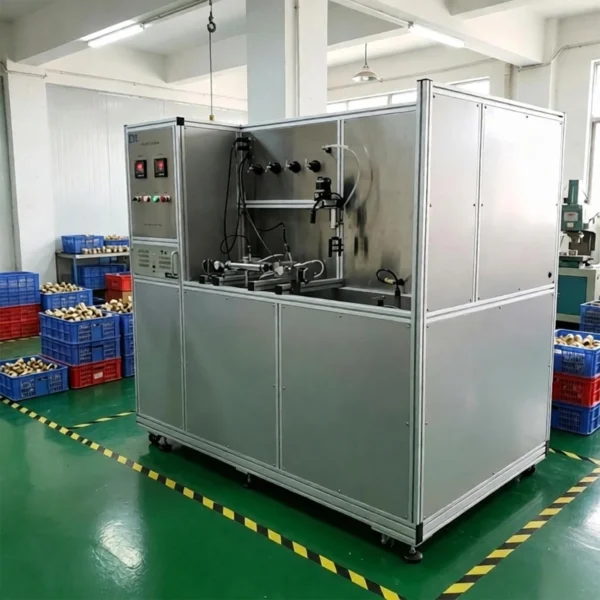

The spout and handle are positioned for easy access and efficient drainage, with ergonomic handles supporting precise operation. The supply pipe bridges indoor plumbing and the exterior, with proper slope guaranteeing full drainage. The stem washer / compression washer provides precise shut-off and pressure buffering — manufacturing tolerance on this component directly affects long-term sealing performance, which is why it’s a CNC machining precision concern, not just a materials choice. The anti-siphon valve / air gap prevents contaminated water from backflowing into the supply, meeting the backflow protection requirements referenced above under North American and European plumbing codes.
For distributors and wholesale buyers, a single freeze-related product failure carries outsized downstream cost: it isn’t just a warranty claim, it’s a homeowner’s insurance claim in a category the Triple-I data shows is already common and expensive — and a product failure that contributes to that pattern reflects on the brand and the buyer’s own supplier relationships, not just the end customer. Freeze resistance and backflow compliance are internal-component decisions, governed by stem length, assembly and packaging precision, and sealing consistency — not something a good exterior finish can compensate for.
| Engineering Factor | Frost-Free Outdoor Faucet | Traditional Outdoor Faucet |
|---|---|---|
| Shut-off valve position | Located inside protected area | Located near exterior outlet |
| Freeze protection method | Self-draining design prevents trapped water | Requires manual draining or insulation |
| Main reliability factor | Internal design and installation accuracy | Seasonal maintenance requirement |
| Manufacturing concern | Stem length, drainage, sealing consistency | Simpler structure but higher freeze exposure |
| Commercial application | Suitable for cold-climate projects | Higher maintenance risk |
| Long-term performance | Depends on design validation and production control | Depends heavily on user maintenance |
The key difference is not simply the presence of a longer stem. The real engineering advantage comes from controlling where water remains after shutoff and ensuring that every manufactured unit performs according to design expectations — which is a production-consistency question as much as a design one.
In 2019, a North American bathroom hardware brand planned a private-label frost-free outdoor faucet series targeting cold-climate residential markets across Minnesota, Wisconsin, and Michigan — positioned as an upgraded replacement for traditional outdoor hose bibs. The initial product review selected a standard structure with a fixed 6-inch stem length, based on a general residential specification. Engineering evaluation found it wasn’t optimized for all target installation environments.
The first issue was stem length versus wall penetration depth. Exterior wall thickness varies significantly by construction type across colder regions, and a shorter stem can leave the internal shut-off valve too close to the exterior temperature zone. Prototype testing on a 4-inch wall assembly found roughly 35–40 mm of the valve area sitting closer to exterior temperatures than recommended. The faucet passed standard water-flow testing normally — but repeated freeze-cycle simulation showed increased stress around the sealing components, exactly the kind of gap a one-time functional test won’t reveal.
The second issue was drainage performance. The original prototype drained acceptably under ideal installation conditions, but testing showed residual water volume varied significantly with installation slope — below the recommended downward angle, roughly 8–12 ml remained trapped in the outlet section after shutoff. That volume sounds trivial until factoring in that frozen water expands roughly 9% in volume, placing repeated expansion stress on internal sealing components with every freeze cycle.
Three engineering changes addressed both issues before mass production:
The commercial result wasn’t something customers could see in product photography — it was a reduction in seasonal failure risk. A single frozen outdoor faucet generates plumber callbacks, distributor complaints, warranty costs, and negative reviews concentrated within a short winter window, all from a component that looks identical to a properly engineered one until the first hard freeze. The reinforcing point for this article: for climate-sensitive bathroom hardware, stem length, drainage capability, sealing tolerance, and production consistency determine long-term reliability far more than exterior appearance — which is exactly why the decision framework above treats these as verification questions for a bulk buyer to ask, not assumptions to take on faith.
Before finalizing a frost-free faucet order for wholesale or private-label distribution, ask:
Installation best practices: certified plumbers ensure the supply pipe extends into the interior, the slope is correct (3°–5°), and all seals are tight. Routine maintenance (monthly/quarterly): inspect joints, handles, and spouts; lubricate the stem and handle; check drainage and seals; replace washers every 1–2 years. Seasonal and extreme-cold measures: disconnect hoses in fall, verify seals, and in extreme cold regions (around -30°F), add interior pipe insulation or exterior faucet covers — consistent with the regional frozen-pipe risk data the Department of Energy publishes for exactly this purpose.
Leaking spout — usually a worn stem washer or loose fittings; replace washers, tighten connections. Residual water after closing — often caused by clogging or improper slope; clean the spout/filter and verify installation angle. Stiff handle — due to lack of lubrication or debris; clean the stem and apply silicone lubricant. Backflow concerns — a missing or failed anti-siphon valve; inspect and replace against ASSE 1019 requirements.
For buyers evaluating supply partners for large-scale wholesale procurement, OEM production consistency and material selection matter more than surface finish alone. A frost-free faucet that looks identical to a competitor’s on a shelf can perform completely differently in the field depending on whether stem length, drainage slope, and internal component tolerance were engineered and verified consistently across every production batch — not just on the sample unit used for the sales quote.
Frost-free faucets keep the shut-off valve indoors, preventing freezing; standard faucets retain water outside and are more prone to freeze damage.
They greatly reduce the risk, but proper installation and disconnecting hoses in winter are still required — leaving a hose attached defeats the self-draining design even on a correctly installed unit.
Typically 10–15 years with proper installation and maintenance, compared to a shorter service life for traditional outdoor faucets exposed to repeated freeze cycling.
Focus on durability, certifications, consistent quality, and manufacturing capacity for large-volume supply — component-level testing history matters more than a supplier’s stated experience alone.
Freeze-proof faucets can leak or stop working if not properly installed, insulated, or drained. Extreme cold can still cause freezing if the stem isn’t extended far enough into heated space, and issues like faulty valves or clogged pipes can also occur.
Michael Zhang is a Bathroom Systems Application Engineer at JEKARE with experience in shower faucet products and installation systems. He specializes in product application, water flow performance, installation practices, and maintenance considerations. By working with both manufacturing and project teams, he helps develop practical bathroom solutions that meet the needs of distributors, contractors, and OEM customers.
Insurance Information Institute (Triple-I) — Facts + Statistics: Homeowners and Renters Insurance https://www.iii.org/fact-statistic/facts-statistics-homeowners-and-renters-insurance
ANSI / ASSE 1019 — Performance Requirements for Wall Hydrant with Backflow Protection and Freeze Resistance https://webstore.ansi.org/standards/asse-sanitary/asse10192011
IAPMO — Uniform Plumbing Code https://iapmo.org/codes-standards-development/code-development/uniform-plumbing-code
U.S. Department of Energy — Turn Down the Temperature, but Don’t Let Your Pipes Freeze https://www.energy.gov/energysaver/articles/turn-down-temperature-dont-let-your-pipes-freeze
✔ 20+ Years of OEM & ODM Manufacturing Experience ✔ Stem Length and Drainage Slope Validated Per Destination Market ✔ ASSE 1019 Backflow-Protection and Freeze-Resistance Testing Support ✔ CNC-Machined Component Tolerance Control Built Into Standard QC ✔ Flexible Customization for Different Regional Climate Conditions ✔ Manufacturing Partner for Global Distributors and Bulk Buyers
JEKARE supports OEM and private-label development across faucets, kitchen sink faucets, and angle valves, backed by engineering review and DFM and production inspection at each stage through our OEM/ODM project process, with warranty terms aligned to each program’s field conditions.